Helena Schrader's Historical Fiction

For a complete list of my books and awards see: http://helenapschrader.com

For readers tired of clichés and cartoons, award-winning novelist Helena P. Schrader offers nuanced insight into historical events and figures based on sound research and an understanding of human nature. Her complex and engaging characters bring history back to life as a means to better understand ourselves.

Showing posts with label Leonidas. Show all posts

Sunday, September 1, 2019

Sparta Rising!

Maybe it was because August is the anniversary month for Thermopylae. Maybe it was just the way things worked out, but August 2019 was brought two important milestones for my Sparta novels.

Most important, I have signed a contract with the Greek firm Alpha Publishers for the release of A Heroic King in Greek by May 2020. The translation is under way, and a PhD candidate in ancient Greek history will look over the manuscript as well to ensure nothing gets lost in translation. The exact timing of the book launch is TBD, but the publisher expects to participate in and capitalize on events commemorating the 2,500th aniversary of the Battle of Thermopylae at Lamia (near the battle site), Athens, Thespeia, and Sparta. He wants me to participate in all of those. I need to step up my Greek studies!


Although less spectacular and significant, readers of English may be more interested to know that I spent the past month re-working my old manuscript "Are They Singing in Sparta?" in preparation for a ebook release under the new title "A Song for Sparta." I've engaged a graphic designer to develop a new cover for the book, and hope to have it on the market by late October or early November. 


Saturday, June 25, 2016

The Youngest Brother - An Excerpt from "Boy of the Agoge"


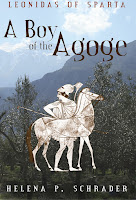
Leonidas, the hero of Thermopylae, was not raised like a prince. Because he was born long after two elder brothers, he was not the heir to the throne and was subjected to the harsh upbringing of ordinary Spartan youth -- the agoge. The first book in my Leonidas trilogy, A Boy of the Agoge, describes what Leonidas' life as a Spartan schoolboy might have been like. In this scene, having failed to be elected leader of his "herd," he is confronted by both of his elder brothers.

At the sound of his name, Leonidas jumped guiltily and turned around to face his older brother. Dorieus was beautiful. In fact, he seemed to embody manly beauty in the abstract, as if he were a throwback to Herakles himself. He was tall for his age. His shoulders were as broad as a grown man's. His arms and legs were a melody of entwined muscle. His belly was flat and hard as if it were made of bronze. He was now an awesome 18 years of age, and so Leonidas had to stand with his hands at his side and his eyes at his feet and call him "sir." 

"Yes, sir," he said dutifully.

Dorieus came to stand directly before him. His head was shaved too, of course, but he was wearing training armor, carried a shield slung on his back, and a real sword hung from his baldric -- something Leonidas couldn't dream about for another ten years.

"Is it true what I hear? That you were not elected herd leader?" Dorieus had been herd leader of his unit ever since he had enrolled in the agoge. He had won the contest of Artemis Orthia at 16. He had innumerable prizes for running, wrestling, javelin and discus. Dorieus was quite simply the most splendid of all the young men still in the agoge -- not excepting even those youths in the age cohorts ahead of him.

"Yes, sir," Leonidas answered the question.

"And why not?"

"Ask the others, sir. They were the ones who voted." Even as he answered, Leonidas stiffened his stomach muscles and braced for the blow Brotus would have given him for such an impudent retort.

Dorieus was made of different stuff. "That was a very facile answer, boy, and you know it. Try again."

"Ephorus is faster and stronger than I am, sir."

"Then why aren't you in the gymnasium improving your strength rather than loitering around the agora looking for handouts like a mongrel dog?"

Everyone in the whole agora (it seemed like the whole city to Leonidas) was listening to them.

"Because, sir, if I get that meat pasty over there, I will have far more strength than if I try to exercise in the gym when I'm half starved to death."

The pastry vendor laughed outright, but Dorieus was unimpressed. "You are either a fool or you are trying to provoke me. The leanest dogs run fastest, and the hungriest lion makes the kill."

"How do you know the hungriest lion makes the kill, sir? Have you talked to one?"

"Now I know you are just trying to provoke me, little brother, but I won't play your silly game. You disgrace our house and our mother, just as Brotus told me you did." Dorieus turned on his heel and departed, everyone in the agora making way for him as if before a reigning king. Leonidas stood in his wake, feeling very small and silly and worthless.

Someone jostled his arm. He looked over alarmed, but it was only the pasty vendor. "Here you go, lad." He offered him one of the good pasties -- not the one picked at by the birds. "Eat up and enjoy it. Don't let that pompous ass get you down."

The vendor was a helot, of course. Leonidas knew that his brother would be appalled if he turned around and saw what Leonidas did next, but he didn't care. He took the pasty and smiled up at the vendor. "Thank you! I won't forget this. When I grow up and have money, I'll buy only from you."

The vendor laughed. His front teeth were missing. "Is that a promise, little Leonidas? Will you make me a purveyor of the Agiad royal house one day?"

"Well, I can't do that," Leonidas admitted with evident regret, "I'm never going to be king. But I'll buy all my own pasties from you, " Leonidas assured him solemnly. He was serious, even if the helot seemed to think it was a joke.

By the time the third of his brothers, Cleomenes, took notice of his failure to win election from the other seven-year-olds in his "herd," Leonidas was rather tired of the whole thing. Besides, he had been raised to look down on this half-brother as something distinctly "inferior" and "distasteful."

Cleomenes was King Anaxandridas' son by "that other woman." Although the ephors had made a great show of setting aside Spartan marriage law and allowing King Anaxandridas to take a second wife, Leonidas had been raised in his mother's household, and she insisted that the ephors ("nothing but a rude coterie of jumped-up royal servants) had no such authority. How could five ordinary citizens (who were not even priests and without the sanction of Delphi!) simply set aside Spartan law? This question, when asked indignantly by the Agiad queen, was clearly rhetorical, and Leonidas had never heard anyone dare to answer her. Even his father, on the one occasion when Leonidas happened to hear her raise this beloved topic in his presence, had only shrugged. The ageing king had been too weary to fight with his queen over this bitter issue.

If the ephors had no right to set Spartan law aside, then "that other woman" was not King Anaxanadridas' wife, but his concubine. Ergo, the child this concubine bore was a bastard -- pure and simple. Queen Taygete never referred to Cleomenes by any other term than "that bastard" -- although the adjectives used to describe "the bastard" varied over time.

At first, on the basis of helot rumors, Taygete had been led to believe that Cleomenes was "sickly" and so he had been "that feeble bastard." Then it was rumored that he was rather wild and self-willed, so she called him that "unruly bastard." When as a little boy of about ten it was reported in the city that he had been caught telling some minor lie, he became "that deceitful bastard." And because, as heir apparent to the Agiad throne, he was exempt from flogging, she called him "that cowardly bastard" -- although obviously Cleomenes had no choice in the matter. Following an incident in which he allegedly showed disrepect for the gods, he became "that impious bastard." So it was this "feeble, unruly, deceitful, cowardly and impious bastard" that confronted Leonidas just outside the monument to Lycurgus one fine, summer morning of Leonidas' first year in the agoge.

Leonidas like most of his fellow "little boys" did his best to avoid interrogations from their elders about what they had (or had not) learned so far by avoiding his elders altogether. At the sight of someone older, most boys tried to dart out of the way without being noticed. Unfortunately, just when he thought he'd made his escape, a mocking voice called after him, "Well, if it isn't my littlest brother Leonidas! Trying to run away like a coward too. Come here, boy!"

With an inward sigh, Leonidas stopped, turned around, and when he stood a yard away from his tormentor, dutifully stopped and faced him. "Sir?"

Cleomenes was a year older than Dorieus and hence 19 years old and should have been a so-called meleirene. But Cleomenes, as the heir-apparent to the Agiad throne, was exempted from the agoge. He did not wear his hair shaved, nor was he barefoot. He was dressed in a simple but fine chiton. Although Leonidas was supposed to keep his eyes down, he couldn't resist one glance at the face of this feeble-unruly-deceitful-impious coward. To his embarrassment, he met his brother's eyes, where were examining him with discomfiting intensity.

Cleomenes could not be called beautiful by any means.  He did not have Dorieus' even features or his broad shoulders and muscular arms and legs. He was tanned and by no means fat, but there was nevertheless a softness about him. Furthermore, his shoulders were narrow and the joints all seemed too large for his limbs, suggesting that his muscles were underdeveloped. His face, too, was somehow misshapen without being actually deformed. He had his father's too large nose, his teeth were too prominent, and his eyes set too close together.

But those eyes were very sharp, and they seemed to miss nothing as they drilled into Leonidas. "So you're the runt of the family, are you?"

Leonidas viewed this as a rhetorical question and said nothing, but Cleomenes snapped his fingers. "I asked you a question, boy."

"Yes,sir."

"Yes, sir, what?"

"I'm the runt of the family, sir."

"Couldn't even get elected herd leader, I heard."

"No, sir."
 

"I like that," Cleomenes answered with a smile that was anything but friendly. "At least you won't have any populist delusions like your elder brother."

Leonidas wasn't sure what he was talking about and held his tongue. Cleomenes' eyes narrowed. "I must say one thing for you, however. You don't look as dumb as your brothers." He paused as if expecting Leonidas to protest, but Leonidas had no intention of making that mistake. So Cleomenes continued with a mixture of provocation and satisfaction. "You're not so dumb, are you, little Leonidas."

Although this too seemed rhetorical, Leonidas did not want to risk another rebuke and answered dutifully, "I wouldn't know, sir."

"If you are half as clever as you look, you'll remember one thing: you are the product of incest, the product of a boneheaded sire crossbred with a dim-witted dam. I, in contrast, am descended through my mother from Chilon the Wise, honored throughtout the civilized world for his intelligence. You won't outwit me, little Leonidas."

Leonidas shook his head dutifully, noting that the "feeble-unruly-deceitful-impious-cowardly bastard" clearly had a long of unpleasant titles for his half-brothers as well.

 Buy a copy of  A Boy of the Agoge in ebook or paperback on Amazon now!

 
https://www.amazon.com/Leonidas-Sparta-Helena-P-Schrader/dp/1604944749/ref=sr_1_1?s=books&ie=UTF8&qid=1466845849&sr=1-1&keywords=a+boy+of+the+agoge


Sunday, September 16, 2012

RELEASED: "A Heroic King"

The third and final book in my Leonidas Trilogy was released yesterday, September 15. It is now available for sale from online retailers.  Here's an excerpt from Chapter 1 to whet your appetite!

 “A bastard?” the Chairman of the Ephors exclaimed in horror. “You’re saying that the ruling Eurypontid King of Sparta is a bastard?”
“I’m saying more than that,” Leotychidas replied coolly. Leotychidas was a tall, lanky man with the large nose typical of the Eurypontids.  He was the ruling king’s closest male relative, albeit only a second cousin, and he was officially his heir because Demaratus, at 49, had yet to produce a son. Leotychidas continued in an aggressive and self-satisfied tone, “I’m saying he does not have a drop of Herakles’ blood in his veins and has no right to sit upon the Eurypontid throne.”
“That's impossible!” A second ephor protested, no less outraged than the first. “He was born to King Ariston’s queen in the royal palace and immediately acknowledged by his father.  He never attended the agoge, and at his father’s death almost seven Olympiads ago he ascended to the throne without question.  He has no brothers. He is the only child King Ariston ever sired.”
“Ariston never sired anyone! He was as sterile as a mule!” Leotychidas sneered. “Have you forgotten he had three wives and the first two, maidens of good stock, gave him no sons, but produced children by their subsequent husbands?”
There was dead silence in the ephorate, the small but venerable building adjacent to the more imposing Council House and backed up against the Temple to Fear.  The five men sitting in the marble, throne-like chairs at the center of the chamber were just ordinary Spartan citizens. They had been elected to a one year term as ephor by the Assembly.  Each man owed his election to a varying combination of a distinguished career in public service, an effective election campaign among his fellow citizens and the endorsements of influential members of Spartan society. Once elected, however, these ordinary citizens collectively became extremely powerful, which was why by law no one could be elected twice. The duties included receiving and dispatching ambassadors, issuing fines to citizens found guilty of breaking the law, and the dismissal of magistrates or commanders accused of wrong-doing. The ephors also served as advisors to the kings and in extreme cases could bring charges against them. 
The men gathered in this room were prepared for these duties. They were not prepared to hear that one of the kings, who had reigned or a quarter century already, was illegitimate. Yet what Leotychidas said was true: Demaratus’ father had had three wives all of whom had had children by subsequent or previous marriages, but only one of whom had ever given Demaratus a child.
Technarchos, the chairman of the five ephors, was a man respected for his hard-work and common sense.  In the army he had risen to the rank of enomotarch, but was passed over for promotion to company commander.  On attaining full citizenship, however, he had been appointed Deputy Head Master of the public school, the agoge, with responsibility for the 20-year old eirenes.  For twenty years he had fulfilled this demanding position with firmness and fairness, but he was not credited with particular subtlety or wit. Recovering first from his shock, he protested simply, “Demaratus was Ariston’s issue by his third wife.”
“Indeed!” Leotychidas agreed eagerly.  “A woman who had been the wife of Agetus, son of Alcides, and borne him children.  There was no question of her fertility, but she produced only one child in her whole, long marriage to Ariston and that son ― Demaratus ― was born too soon to have been sired by the king.  He was the son of Agetus.”
“That cannot be!” One of the other ephors, a man who had benefited from Demaratus’ patronage, insisted frowning. “Why would Ariston raise up the son of another man as his own?”
“Because he was ashamed to admit his impotence, and because he wanted to deny me my rightful place,” Leotychidas retorted sharply, adding in a more reasonable tone, “You need not take my word for it.  I have found a witness, a man who was ephor the year that Demaratus was born and he can bear witness to the fact that King Ariston knew Demaratus was not his son.”
The ephors looked at one another in astonishment.  It was 49 years since the birth of Demaratus. Since the legal minimum age for election to the office of ephor was thirty-one and ephors were usually men in their forties or fifties, any surviving ephor from the year of Demaratus’ birth would now be close to ninety years of age.  None of the men present were aware that such a man still lived.
Leotychidas opened the door leading directly into the Temple of Fear, and called into the darkened temple. He held the door open while a very decrepit old man, bent with age and clutching the arm of a young helot, entered the chamber.
The old man had so little hair left that he could not plait if from the forehead in the Spartan fashion and it was simply combed back over his scalp until it could be bound into a single, thin braid at the back of his neck.  The skin on his face and neck was splotched with age-spots and sagged upon his fleshless bones.  His eyes were grey with cataracts, and his mouth seemed to cave into his toothless mouth.  He shuffled forward until the helot holding him up came to a halt in front of the five city officials. There he just waited.
Techarchnos cleared his throat and asked politely, as was appropriate when faced with a man of such a venerable age, “Who are you, father? And why are you here?”
“I am Lakrates, son of Paidaretos,” he said in a surprisingly firm voice although his words were slurred somewhat for lack of teeth. “I am almost 100 years old, but I am here to be heard.”
“We are listening, father,” Technarchos assured him.
“Then listen well! I was ephor in the reign of King Ariston. On the very day that Demaratus was born, we five ephors were attending upon King Ariston when a messenger burst in upon us to announce the birth of a child to Ariston’s new queen.  Ariston was most astonished and in front of us he counted on his fingers the months since his marriage and ― with an oath ― declared ‘The child cannot be mine.’”
“But he accepted Demaratus! He brought him to the Elders! He doted on the boy!” The ephor who owed his post to Demaratus’ patronage protested with evident alarm.
“That may be,” the old man admitted pressing his lips together so that they completely disappeared into the cavity of his mouth. “But that does not change what he said,” he added stubbornly, and insisted, “He counted on his fingers and declared Demaratus could not be his child!”
“But why did you and the other ephors keep silent about this?” One of the other ephors asked skeptically. Although he owed Demaratus no particular favors, he was a reasonable man and found it hard to credit that such a significant utterance could simply have gone unnoticed for half a century.
“We did not! We told the Gerousia, but they were displeased. They were all Ariston’s men!” The old man spat out bitterly and his foul breath made the ephors recoil involuntarily, but the old man continued passionately. “They said the Eurypontid king had need of an heir and if the Gods had seen fit to give his queen a healthy son, then a month or two did not make any difference.”
Since a man had to be over sixty to be eligible for election to the Gerousia, members of this body at the time of Demaratus’ birth were all long since dead. No one could prove or disprove the accusation of the old man, but there was no denying that there had been a period when the Gerousia was dominated by clients of King Ariston.  They had been elected when the Agiad King Anaxandridas was still too young to have much influence with the citizens.  Only after they died out, was Anaxandridas able to balance out the composition of the Gerousia by getting some his own candidates elected in Assembly.
“I say the Gods have made it perfectly clear that Demaratus was not meant to become king since he too has failed to produce an heir,” Leotychidas took up his appeal. “I, in contrast, have three fine sons. That alone should tell you where the Gods stand in this dispute!”
The ephors looked with varying degrees of alarm and discomfort at their fellow citizen. Although Leotychidas was not without his supporters, he was far from popular and had never distinguished himself either at arms or in other forms of public service.  What he was asking seemed utterly impossible to these five ordinary men, who for more than a quarter century had seen in King Demaratus a descendant of Herakles and representative of the Gods on earth.
The situation was particularly delicate because the ever erratic Agiad King Cleomenes was clearly going mad.  Last year after a decisive victory over Argos, he mindlessly slaughtered captives, burned down a sacred wood and ordered the army to withdraw rather than destroy the city of Argos once and for all. Since no one trusted Cleomenes any more, Demaratus was effectively Sparta’s only king. To suggest that he was not rightfully king, effectively made Sparta kingless ― at least until the issue could be resolved one way or another. Without a king to command it, Sparta’s army could not take the field.
The more he thought about the implications, the more Technarchos felt as if his head was spinning. He was a man with an acute appreciation of his own limitations, and he recognized that this dilemma was beyond him. He resolved to speak privately with the one member of either royal family who had over time repeatedly demonstrated strength of character and leadership capabilities, Leonidas. Out loud, he declared, “We must consult with the Gerousia.”
Leotychidas smiled a crooked, sinister smile and shrugged, as he replied. “But of course. Consult the Gerousia.  But I am the rightful Eurypontid king and when I have been recognized, I will remember who sided with me and who tried to stand in my way ― even after the truth had been revealed.”

Sunday, September 9, 2012

"Leonidas of Sparta -- A Peerless Peer" -- An Excerpt from Chapter 1

Cleombrotus was Leonidas twin brother. The news that Leonidas had killed a wild-boar reached him in his tent, where he was dicing with his seven mess-mates. Hearing that Leonidas had broken an arm in the encounter, Cleombrotus snorted and remarked contemptuously, “Lucky someone was around to rescue him from worse harm!”
When they had been little, Cleombrotus had been significantly bigger and stronger than Leonidas and had used both advantages to bully his brother. In the agoge they had been separated and rarely met, but Cleombrotus continued to excel, particularly at boxing, eventually winning in the youth competitions at Olympia. He had won the honours at the Feast of Artemis Orthea as well, and carried the title and trophy for life. Throughout these early years he had looked down on his smaller twin, sneering at him for failing to be elected herd-leader, for failing to win honours or Olympic laurels. But last year everything had turned upside down and bitter when both youth were 20 year old instructors at the agoge called eirenes. Cleombrotus’ lost his command after a case of unprecedented insubordination by his unit resulted in it being turned over to his twin brother.
 “That’s not what Alkander is saying,” the man who had brought Brotus the news noted.
“Alkander?! That trembler! He p-p-probably shit at the sight of the b-b-boar and didn’t notice what was g-g-going on.” Cleombrotus imitated the stutter that Alkander had had as a boy to the amusement of his companions.
When they stopped laughing, however, the messenger put him right. “You better come see the carcass first, Brotus. It’s huge! It took four men to carry it and the tusks are at least two-feet long. Alkander held it down with his spear, while Leonidas stabbed it with his sword ― they weren’t hunting and didn’t have a proper boar-spear with teeth  ― just their standard-issue war spears, which were still in it when Demaratus got there.”
“Demaratus?! What the hell was Leonidas doing hunting with the Eurypontids?” Cleombrotus made it sound like treason.
No one bothered to answer because everyone knew that Leonidas and Alkander had been friends since boyhood, long before Alkander’s sister married Demaratus. “Come and see for yourself.” Brotus’ comrade suggested sensibly, and they all tumbled out of the tent to have a look.
Torches were forbidden in a Spartan camp no less than in the city of Sparta, but they didn’t have much trouble finding the source of commotion. It was, after all, not yet late and most men had not gone to sleep. The arrival of Demaratus with this immense trophy had brought many men out of their tents, and word had rapidly spread that Leonidas had killed it.
Despite himself, Cleombrotus was impressed. The boar was the largest specimen of the species he had ever seen. Nor could he comfort himself that the beast was old, decrepit or lame. Not a hair was grey and there was not another injury upon its body but the ones sticky with fresh blood. The boar was muscular with bristling black hair and eyes that ― even in death ― were full of power and contempt for lesser creatures. How could Little Leo have vanquished such a beast? For the first time in his life, it occurred to Brotus that Leonidas might have qualities that he had failed to notice up to now. Leonidas, he registered, might be more than he appeared to be.

Saturday, March 31, 2012

Writing about Thermopylae: Part II

Last week I talked about my initial reluctance to write about Thermopylae and the reasons for it. Today I want to focus on one particular aspect: the literary challenge.
 
The way I see it, if I were writing about Henry V of England, the historical record might be my guide, but Shakespeare would be my competition. And nothing about the real Battle of Agincourt would be so challenging as Shakespeare’s magnificent depiction of it. Never mind that the words he put into Henry’s mouth were never said by him – indeed, were probably based on the speech Edward of Woodstock made before Poitiers as recorded by Chandos’ Herald. Shakespeare remains the benchmark for any book of fiction about Henry V. Fortunately, I’m not writing about Henry V!

However, Thermopylae too appears in a number of works of fiction, and these have shaped our understanding of it and laid down the literary hurdles that any new book on the subject must successfully clear. I was personally introduced to Thermopylae – and indeed Ancient Sparta – by Caroline Dale Snedeker’s novel The Spartan. I read this book as a teenager, and it impressed me so much that I retained a life-long, if initially latent, interest in Sparta. I remembered it as a book about Thermopylae. But when I purchased and read it in preparation for my own description, I discovered that of the two hundred pages, only thirty-five were devoted to the battle, of which ten were the march north. Even the remaining twenty-five pages shy away from the issue in that they describe the fate of Aristodemos, the hero of the novel, and one of the two Spartiates who survived Thermopylae. Aristodemos, Herodotus tells us, was blind and behind the lines and did not actually fight, at least not on the last day. Snedeker’s account skirts around Thermopylae more than it describes it.
 
The opposite is true of Steven Pressfield’s Gates of Fire. Pressfield’s book starts and ends at Thermopylae and everything in between is more or less a device for making us identify with and understand what happened there. Rather like Shakespeare, Pressfield is a better story-teller than historian. It was reading Gates of Fire that reawakened the latent interest in Sparta that Snedeker had sparked in me decades earlier, and after reading Gates of Fire, I started doing research on ancient Sparta.  Being a historian, I read history books. My research slowly and painstakingly produced a vision of Sparta markedly different from Pressfield’s. Yet his story-telling is compelling, as the success of his novel proves. Pressfield is therefore the modern bench-mark for any fictional account of Thermopylae.
 
Before attempting my own account, therefore, I re-read Gates of Fire. The issue was not if or how historically accurate his account was, but rather how did he deploy his characters and evoke emotion? How did he make his story-telling so effective? Was there any point in going “toe-to-toe” with an internationally best-selling author? Or should I, like Snedeker, find a way of evading the issue? Most important, was there anything that I could say about Thermopylae that hadn’t already been said?
 
Astonishingly, when I re-read Gates of Fire, I came away feeling that Pressfield had done a magnificant job of describing male bonding on a battlefield and that his Thermopylae was very much about blood and guts and heroes. It uses the language of modern fighting men. It speaks to modern fighting men. It is a tribute to fighting men of all nations and ages.

But is that all that Thermopylae was and is that all it means to us?

Pressfield’s heroes are already crippled by the end of the first day of fighting, yet continue to perform feats of super-human strength and endurance, heedless of pain and physics for another two days. Pressfields heroes are demi-gods – like Achilles and Hektor.

But Leonidas was a real human being, a historical, not a mythical figure. So were the other 300 Spartans and 700 Thespeians. They all had real names, real (not divine) parents, and they felt real pain. They had only the strength of real men. Shouldn’t we honor them for what they were, rather than turn them into supermen?
 
Many people want supermen, cartoon-heroes, supernatural heroes. For them, there are lots of “Leonidases” on the market from films and cartoons to PC-games.
 
But it seems to me there are too few portrayals of Leonidas as a complex, human being, and this, I realized, could be my contribution to the literature on Thermopylae. My Thermopylae, I decided, would be about human beings doing exceptional, but not super-human things. And so at last, I sat down and wrote about Thermopylae.

Saturday, March 24, 2012

Writing about Thermopylae: Part I

I’ve been working on the Leonidas Trilogy for a number of years now, and – obviously – from the very start I have known that the book would end at Thermopylae.

OK, I admit, there were some days when I thought: “Do you really have to do that? Hasn’t everything already been said? Wouldn’t it be enough to end the book as Leonidas marches north?”

But reality always set in relatively quickly. People read about Leonidas because of Thermopylae. They want to read about Thermopylae. If I didn’t write about Leonidas at Thermopylae, my readers would feel cheated. It doesn’t matter that my declared objective is to write about his life, not his death. So, I accepted my fate. I would have to write about Thermopylae – but first I had all the rest of the book(s) to write….

It was wonderful. With each chapter I came to know – and like – Leonidas better. I met his friends. Watched Gorgo grow up, become an alluring woman and partner for Leonidas. The project grew and evolved. There was so much to tell! But with each completed chapter, I was a step closer to Thermopylae.

At some indefinable point I started to unconsciously slow down. Oh, I had lots of good excuses. I had guests. I had work. I had to work on many weekends. I was even Acting Consul General for a while. But in reality I was procrastinating. I didn’t want to face Thermopylae.

Why?

Well, frankly, I don’t like killing people. Certainly not people I like. And I like Leonidas – and Alkander and Prokles and Maron and…. You get the picture.

The far greater problem, however, was the competition. Precisely because so many people from Herodotus onward have already written about Thermopylae, my readers have expectations. Unlike most fiction, where the author’s only burden is to carry an inert reader along, fiction describing a familiar incident means dragging the reader in directions they may not expect to go. In the first case, your reader is on a raft and you are the current of the river. In the second case, the reader is in a power boat trying to go in the direction he wants based on the charts provided by descriptions familiar to him.

The direction of the river, of course, is set by history. I can’t change that. (Well, some novelists do, but I’m a historian.) I can’t have Leonidas escape alive – and I wouldn’t want to. So the first thing I did was sit down and read as many accounts of Thermopylae as I could readily get my hands on. I make no pretense of reading everything, but I believe my reading covered a sufficient spectrum to be called comprehensive, starting with Herodotus, Bradford, Fields, and Holland. I also visited the physical site and walked around the battlefield myself.

The combination of research and personal inspection gave me the skeleton for the story. I knew the geography, climate, and the bare facts. That was the easy part.

The greater challenge, however, was confronting the literary aspects of the story. But enough for today, I’ll talk about the literary challenges next week.

Saturday, September 3, 2011

Thank You! and now "A Peerless Peer..."

Dear Followers,

Thank you for participating in my three surveys on the title, subtitle and cover image for the Kindle Edition of Chasing the Wind. There was considerable concensus that the best title is "Where Eagles Never Flew" -- although one or two of you confided in me well-founded reservations. After consulting with the publisher, however, the decision was made to go ahead with Where Eagles Never Flew as the title for the Kindle book.

Although the largest number of readers preferred the longest suggested subtitle, the publisher and cover designer vetoed this for practical reasons. The cover of a Kindle book never appears as anything more than a "thumbnail" and space is therefore at a premium. The publisher felt that we couldn't afford to spend so much "real estate" on the sub-title -- which would probably be almost illegible on a thumbnail anyway. So we opted for the shortest of all sub-titles: "A Battle of Britain Novel."

The cover was also a close call, with a slight plurality in favor of Cover 1. I have asked the designer to look at ways of combining the key features of these two covers and come up with a new design that meets the publisher's preferences but includes some of the features of Cover 1 that (from talking to some of you) was the main appeal of this design. 

Otherwise, all is on track for the release of Where Eagles Never Flew in about 3 weeks time. I will be sure to post information about the release on this blog. 

Leonidas of Sparta: A Peerless PeerMeanwhile, the second book in the Leonidas Trilogy, Leonidas of Sparta: A Peerless Peer is available for purchase on amazon.com in both trade paperback and Kindle formats. For more information about the Leonidas Trilogy you can also go to the dedicated website: http://sparta-leonidas-gorgo.com/


Sunday, June 12, 2011

Leonidas of Sparta: A Peerless Peer -- Chapter 1, Scene 2

“Master! Master! A catastrophe!” The slave burst into the symposium, at which his master was hosting a dozen important guests. “A horrible accident!” the slave gasped out.

Archilochos’ symposia were famous for the quality of their food, entertainment, and conversation. Wealthy, well-traveled, and active in politics, Archilochos prided himself on employing the best cook and serving the most coveted wines in all Corinth, because he found both useful bait to pull men into his circle. He was, at the moment, exceedingly pleased to have snared one of the Spartan kings, Demaratus.

King Demaratus was not a handsome man. He was short and bowlegged and had a very large nose. Aware of this, he was not vain about his person, and he dressed in the practical clothes of a common ranker in the Spartan army, without any hint of his royal status. He braided his hair from the roots, as was custom, and bound the tips with tarred twine like marines did. Despite this almost defiant refusal to dress like a king, however, he was very conscious of his royal dignity and sensitive to slights to his status.

Despite the superficial differences between Demaratus and the elegant and cultured Archilochos, they found common ground in their opposition to the other Spartan king’s plans to make war on Athens. They met tonight to discuss ways of putting an end to the ill-advised adventure; and Archilochos deplored the unprecedented interruption of a slave, who had no business in the symposium for any reason.

“Stop babbling!” Archilochos snapped at the hysterical old slave.

But the slave was Lychos’ tutor, the man who had watched over him when he was growing up, and he was far too distressed to calm down. “Lychos has been gored by a wild boar. They say he was tossed around in the air, speared on the tusks of the boar, and his guts were spilling out of him!”

“Who says? What are you talking about?” Archilochos started to focus on what the man was saying.

“Master Lychos is bleeding to death! He―”

“Calm down and give me a coherent report!” Archilochos ordered, alarm rather than outraged propriety lending his voice an edge now.

Except for Demaratus, Archilochos’ guests were all Corinthian aristocrats who knew their host’s son personally; they exchanged horrified glances. Even Demaratus knew that his host had lost one son at sea, and guessed that this youth was Archilochos’ heir.

“He was riding beyond Acrocorinth when his horse shied at the sight of a boar, and he was thrown to the ground, and the boar gored him!” The slave was trying desperately to get his master to do more than stare at him in horror.

“Where is he?” Archilochos demanded.

“In the forest on the far side of Acrocorinth!”

“He’s still out there? But how did you hear of this?” Archilochos demanded, rearing up from his couch.

“A Spartan! A Spartan found him and killed the boar, but he could not bring him back. He only just managed to capture his horse and ride to Pytheas for help.”

“Pytheas?”

“Of course!” The slave was impatient with his master’s slowness. “Lychos was riding out with Chambias, and Chambias gave instructions to his own house.”

“Why didn’t he come himself?” Archilochos demanded in terrified outrage, his anger an expression of his unfathomable fear. He could not lose this son, too!

“Chambias broke his knee falling from his horse. Lychos―”

“They left him out there? Bleeding to death?” Archilochos grabbed for his himation, fumbling for his sandals.

Demaratus had never seen a grown man look so lost and helpless.

“The other Spartan and Chambias stayed with him, but we must get help to him! Master, we must get the surgeon!”

“Don’t give me orders, slave!” Archilochos snarled back, and only then remembered his guests. He turned to them, unseeing, muttered “excuse me,” and was gone, the old slave in his wake.

The other men collected their himations and slipped their feet into their sandals. The owner of the flute girls shooed them away while they chattered excitedly like a flock of chickens. Demaratus, however, took his time. While the other guests departed, he tied his own sandals and deliberately wrapped his thick red himation around him. Then he set his cross-crested helmet on the back of his head, the nosepiece on his forehead, and followed the others out.

Just as he had expected, he found his host in the outer courtyard. By now Archilochos had sent for a surgeon and ordered his horse tacked up, while a crowd of slaves collected in the courtyard carrying stretchers and torches. Demaratus moved calmly into the maelstrom of activity swirling around Archilochos.

Archilochos was in no mood for any distraction, and he scowled in annoyance at the Spartan king. “Forgive me, but this must take precedence—”

Demaratus waved him silent. “Of course. I merely wanted to reassure you. If two Spartiates were at the scene of the accident, then you can be sure they did all that could be done to save your son.”

“You don’t even know who they were! How can you be so sure? Ordinary soldiers are no surgeons!”

“Spartiates have gone through the agoge, and they are huntsmen. They know how to treat wounds caused by sword and spear, claws, teeth, and tusks, as well as how to handle other common injuries from sprains to broken bones. They will have done all that is possible for your son until a surgeon can see him.”

Archilochos was in no mood to listen, so Demaratus stepped back and let him go, but he called for his own horse. His helot attendant came forward at once, having anticipated the order and having already tacked both their horses. Demaratus swung himself easily onto the animal’s back and followed in the wake of Archilochos’ noisy party with their many torches.

They did not have far to ride. Just behind the huge Doric temple to Apollo, they stopped beside a house ablaze with torchlight. All the neighbors had lit torches, too, and slaves filled the street; the women crowded the balconies, shrouded in their shawls so that only their eyes showed.

Archilochos was met at the door by a man with long white hair and a flowing beard, who assured Archilochos that his own rescue party had set out a quarter of an hour earlier. Archilochos, however, was not calmed, and insisted on following them. Proceeding at a jogging pace along the long avenue leading out of the city to the west, they overtook the priest’s rescue party before it had passed out of the city walls.

Demaratus tagged along, unseen by the others, until he suddenly cantered past the rest of the party to the young man who was leading them. He drew up sharply, his horse’s hooves skidding on the paving stones. “Alkander! You? You killed this boar?”

“It was Leonidas who killed him. I merely pinned him down.”

They gazed at one another while the Corinthians came to a halt in confusion.

“What is this? We must hurry!” Archilochos demanded, riding up beside Demaratus.

“Indeed. And so we shall. Let me introduce my wife’s brother, Alkander.” Demaratus hesitated, but then he decided it would eventually come to light anyway. “And you need not fear that your son’s rescuers were ‘ordinary soldiers.’ The young man who killed the boar is none other than Leonidas, son of Anaxandridas and brother to King Cleomenes.”

Saturday, May 28, 2011

Leonidas of Sparta: A Peerless Peer -- Chapt. 1, Scene 1, Excerpt 6

Chambias felt guilty for his earlier hostility to the Spartans. “Thank you. We would both be dead if you hadn’t happened along.”

The Spartan’s expression grew serious again. “Your friend needs a surgeon. Are you from around here?”

Chambias nodded and then, remembering his manners, added, “I’m Chambias, son of Pytheas; and that is Lychos, son of Archilochos.”

The Spartans flinched―as if they recognized the name―but made no comment. The spokesman merely asked, “Will your horses run home and alert someone about the accident, or should we chase after them?”

“Mine will probably run home. Lychos’ mare is better about staying.”

“I’ll see if Beggar and I can catch her,” the darker Spartan said to his companion; and whistling to his hunting dog, he set off. She was one of the big Kastorian hounds bred in Lacedaemon and admired around the world for their acute sense of smell, tenacity, and intelligence. This one had an ugly white patch on her face that would have made a wealthy Corinthian scorn her, Chambias noted; but she had certainly attacked the boar fearlessly. Now she bounded after her master with an eagerness and agility that was both beautiful and touching.

Chambias watched man and hound disappear behind the stunted trees and then turned awkwardly to the remaining Spartan. He found it disconcerting that because Spartans all wore identical red chitons and cloaks, he could not tell if this young man was rich or poor, the son of someone powerful or powerless. Up to now, he had always been able to tell at a glance whether he was dealing with someone of consequence. Now he could not.

The strange young man drew a goatskin off his back and offered it to Chambias, who accepted gratefully, only now conscious of how thirsty he was.

“Are you with the Corinthian army?” the Spartan asked.

“Not yet; we’re both ephebes―in the cavalry,” Chambias added proudly. “And you?”

“Peers,” the Spartan answered simply—and inadequately from Chambias’ point of view—but the yapping of a dog distracted them and they turned in the direction of the noise. A few moments later the other Spartan reappeared, leading Lychos’ black mare. “If you can climb up on that rock,” he suggested to Chambias, “you should be able to mount despite your leg.”

Chambias looked at the indicated rock, at his friend’s sweating and clearly nervous mare, and then down at his knee. The mere thought of trying to mount and ride with this knee made him nauseous. If the horse spooked and he was thrown a second time, it would be unbearable. He shook his head. “Can’t either of you ride for help? I can direct you to my father’s house. It is directly behind the Temple to Apollo; he is the chief priest.” Chambias felt it was important that these Spartans realize that even though he was not as rich and important as Lychos, he was not a nobody.

The Spartans glanced at one another, and for a moment Chambias feared that neither of these ordinary Spartans was capable of riding; most Corinthian foot soldiers had little skill with horses. But then the darker of the two decided, “You had better go, Alkander. Beggar and I have a better chance of fighting off any predators.”

The Spartan addressed as Alkander, the Apollo-like blond, frowned and seemed inclined to contradict, but the other Spartan shook his head once and the blond accepted the decision. Wordlessly and effortlessly he vaulted onto the mare before turning to Chambias for more instructions. These given, he trotted away, leaving Chambias with the other Spartan.

The latter went at once to check on Lychos, but quickly turned back to Chambias. “Could you lend your friend your chlamys? He is dangerously cold.”

“Of course.” Chambias was ashamed he had not noticed himself. The Spartans had, after all, already shredded one of their cloaks for bandages and wrapped Lychos in the second. Chambias pulled his short cape off his back and the Spartan came and took it from him. The Spartan seemed to hesitate as he noticed that the garment was of the finest wool, dyed a costly turquoise blue with an elaborate border. It was obviously very expensive. “It’s all right,” Chambias insisted. The Spartan returned to Lychos and, kneeling on one knee beside him, carefully tucked the chlamys around him.

Now that he was without a cloak, Chambias noted that the sun was behind the western mountains and it was getting chilly. He looked again at Lychos, who was rolling his head back and forth in evident pain. Chambias registered for the first time that it could take hours for someone to get here with a stretcher or litter. By then Lychos might be dead. Even if the bleeding had slowed, only the Gods knew what damage had been done to his insides. It would also soon be dark and, as the Spartan had already hinted, there were other wild beasts that might be drawn by the smell of blood.

The Spartan seemed to sense what was going through Chambias’ head, because he abruptly broke in on his thoughts. “Alkander is a good rider, and we visited the Temple to Apollo this morning. He will find your father’s house without trouble. Meanwhile, it’s a fine night. The only thing I’m worried about is that the carcass of the boar may draw scavengers.” He pointed to the wheeling vultures overhead. Finishing his thought, he added, “I’ll build a fire to warm your friend, keep the wild animals away, and help Alkander find us again. Do you have bears or wildcats here?”

“No bears; but the cats, although small, are very vicious. And there are wolves, of course.”

The Spartan nodded and started to collect dried wood, of which there was plenty. As he worked, Chambias noticed that he was holding his left arm cradled at his waist and working only with his right hand.

“Are you hurt?” Chambias asked as the Spartan went down on one knee to build the fire, still cradling his left arm.

“The boar broke my left forearm as I went in for the kill. That’s why I sent Alkander for help.”

Chambias was ashamed to think that they were both suffering from broken bones and the other was doing all the work. “Can I help?” he asked.

“If you could strike the flint it would be a big help,” the Spartan admitted with a smile.

Chambias looked blank.

“It’s here. In my hip pouch.” The Spartan indicated the leather pouch that hung from the right-hand side of his belt.

Chambias hobbled over, reached inside, and withdrew the flint; but the Spartan had to explain how to use it, and it took Chambias several tries before he managed to strike a spark. It took many more tries before he ignited the pile of dry leaves and twigs the Spartan had so carefully prepared. “I’ve never done this before,” Chambias said, defensively excusing his obvious incompetence. “We have slaves to light our fires.”

The Spartan nodded ambiguously, blowing gently to stoke the fire and then feeding it from the pile of kindling he had collected. Only after it was going solidly did he again turn his attention to the Corinthian, suggesting, “We might as well eat some of that boar.”

This was going too far. It wasn’t just that Chambias hadn’t the faintest idea of how to go about flaying a carcass; he also did not think it a proper task for a youth of his station. No priest sullied his hands with the meat of the sacrificial beasts. His father employed no less than three professional butchers to flay and filet the sacrificial animals. They were skilled men, but all were slaves or former slaves.

The Spartan apparently understood his look of outrage and shrugged. “If you aren’t hungry, we don’t need to bother. I can go without.” He then settled down to feed the fire.

“Have you spent the night out in the open before?” Chambias asked, glancing nervously at the darkening sky.

“Many times; haven’t you?”

Chambias shook his head. It had never occurred to him that spending the night out in the open might be something desirable. In his experience only beggars, vagabonds, and shepherds slept out at night. It was a mark of status that he had never done so―but somehow this Spartan had managed to turn things on their head and make it sound like a deficit of some kind.

So they sat in silence, the Spartan feeding wood to the fire with one hand while his bitch gnawed happily at the carcass, and Chambias miserably listening to his best friend die.

Sunday, May 22, 2011

Leonidas of Sparta: A Peerless Peer - Chapter 1, Scene 1 - Excerpt 5

Chambias saw his death in the malicious eyes of the black beast.

Lychos flung himself off his horse, grabbing his cavalry javelin from his back. He landed between the boar and his friend and hurled the javelin with all his strength. It was a gallant but futile gesture. The cavalry javelin was not designed to penetrate the tough hide of a boar.

The javelin glanced off the boar’s shoulder without even slowing him down. An instant later, the boar rammed his tusks into Lychos’ belly, and the youth crumpled forward.

The boar lifted his head with Lychos draped across his now bloody tusks and shook his head from side to side, with slow deliberate shakes. The beautiful gored youth screamed in agony as his guts were ravaged by each jerk.

Chambias staggered to his feet, screaming. He tore his chlamys off his back and tried waving it at the boar in a frenzied attempt to distract him. His friend’s blood was splattering everywhere as he hung like a limp doll on the tusks of the boar. Only his rasping screams gave evidence that he still lived.

Chambias could barely stand because of his shattered knee. His own two javelins had spilled onto the ground when he fell, and they now lay out of reach. He had no other weapon on him but his knife—a weapon far too short to damage a boar of this size, even if he could have thrown it with accuracy. He knew he had no chance of saving his friend or himself.

Out of nowhere, two men appeared on the run. They paused only long enough to grasp what was happening, and then reversed their spears from an underhand to an overhand grip and started to advance on the still-raging boar with a deliberation that made Chambias scream at them. “Hurry! He can’t last much longer! Hurry!”

The two men ignored him. His friend was dying with each shake of the boar’s massive head, yet the two men approached only with wary deliberation. Then, with a single exchanged glance, they raised their spears in a double-handed grip. The sun glinted briefly on the tips of the spearheads, and they brought their arms crashing down in almost perfect unison.

The boar saw the danger too late. He managed to toss the limp body of Lychos into the nearest gorse bush and turn toward his attackers, but by then they had already struck. The boar crumpled onto his right haunch, but he was far from dead. Grunting his outrage, the boar shook his bloody tusks and flailed wildly with his forelegs, trying to regain his footing.

From out of the underbrush, the Spartans were suddenly joined by a hound. She threw herself into the fray without a second of hesitation. While the men impaled the boar, pinning it to the earth with the weight of their bodies, the dog leaped onto the boar’s back and tried to bite down on the spine just behind the boar’s head. Yet the wild animal was not subdued.

It was now evident to Chambias that his rescuers had not come prepared for boar hunting. They had attacked with ordinary war spears. These did not have a cross guard and were thinner, less sturdy. Chambias groaned in horror as he heard the unmistakable crack of a spear breaking.

“Hold him!” the man with the broken spear shouted urgently to his companion. The latter flung his weight forward onto his own spear a second time, while his friend stepped back, reversed his spear, and used the butt end―the “lizard sticker”―to gore the boar a second time.

This, too, failed to kill the boar, who with an abrupt, twisting motion sent the dog catapulting through the air. The man with the long spear gave a shout of alarm, realizing he could not hold the boar alone much longer, and instantly the man with the broken spear abandoned it to draw his sword.

With alarm Chambias registered that the sword was ridiculously short; yet that did not deter the swordsman. The man lunged forward and sideways―not, as Chambias expected, for the jugular, but to thrust the sword deep into the chest cavity of the boar from behind the right elbow. He ran the sword in all the way to the hilt. The boar thrashed violently with his forelegs one more time; but then the life went out of his eyes, and he sank down on the ground with an audible thud.

The two strangers were breathing very hard and dripping sweat, as they stared at the massive beast they had only with difficulty managed to dispatch between them. Their red chitons and himations identified them as Spartans, but Chambias could think only of his friend. “Lychos! Lychos!” He staggered forward, dragging his injured leg.

His cries and sobs of pain drew the attention of his rescuers, and they went over to where Lychos had been flung. Together they retrieved the bloody body from the bushes and stretched it out in the small clearing. The hound, having recovered from her toss into the bushes, ran frantically around them, panting in evident agitation.

“Is he alive?” Chambias asked, still hobbling painfully over.

“Yes,” came the succinct answer; and then as Chambias got nearer, he could hear and see for himself that his friend moaned and writhed, trying to stanch the bleeding and pain in his abdomen. The two Spartans, meanwhile, had opened Lychos’ belt and sliced through the Egyptian linen of his bright yellow chiton to get a look at the wound. Chambias tasted his lunch in his mouth as his friend’s innards slithered out of the gaping wound. The Spartan who had dispatched the boar deftly shoved the innards back inside the wound and held it firmly closed in a grip that made his knuckles go white under the blood of boar and man mixed together. Meanwhile, the other set about tearing one of their red cloaks into bandage strips and winding these firmly around Lychos’ torso. Lychos screamed in pain as they worked, but they ignored him for his own good. When they finished, a broad band of scarlet held the wound closed and slowed the hemorrhaging. The second man then yanked off his himation and covered Lychos with it, tucking it in all around him and even winding it around his head so that he looked like a corpse, with only his face exposed.

“Will he live?” Chambias asked.

The Spartans looked over their shoulders and up at Chambias. To Chambias’ astonishment, the two men looked hardly older than himself. One possessed the kind of classical features that the sculptors liked to put on statues of Apollo. He had short, curly blond hair, bright blue eyes, and gentle lips. Chambias couldn’t help thinking he must have had lovers fighting over his favors as a boy. The other was less beautiful, with light-brown, coarse hair and green-gold eyes; but he was taller and broader than his companion, and he was the one who had thrust his short sword deep enough into the boar to kill it. It was also this youth who now replied. Without answering Chambias’ question, he stated, “You’d better sit down and let us tend to your knee.” He nodded toward Chambias’ leg, already discolored and swelling.

Chambias didn’t have the strength to protest. He hobbled toward a large boulder where, with an involuntary gasp, he eased himself down. The Spartans followed, the blond already working deftly to rip up what was left of the cloak they had shredded to bind Lychos’ wounds. When he started bandaging Chambias’ knee, however, the pain was so intense that Chambias had to bite down hard to keep from crying out. Everyone knew the Spartans scorned anyone who couldn’t endure pain with equanimity, and Chambias did not want to disgrace himself or his city. Despite what he wanted, however, he was trembling all over, and he could not hide that. He stammered an apology, “I don’t know what’s the matter with me. I’m not usually like this.”

While the blond Spartan continued with the bandaging, the other tossed Chambias a smile and remarked, “Hopefully, you don’t regularly get yourself nearly killed! Don’t worry about it.”


Friday, May 13, 2011

Leonidas of Sparta: A Peerless Peer - Chapter 1, Scene 1 - Excerpt 4

“But it would be exciting to go to war!” Chambias admitted to his friend Lychos with a grin, as he let his stallion stretch out his neck.

The two Corinthian youths, sons of leading families, were returning from Acrocorinth, where they had been trying to get a glimpse of the Spartan army. The Spartans had invoked the defensive treaty with Corinth and her other allies that required the allies to follow wherever Sparta led. For days now, allied contingents had been pouring into Corinth in response to the Spartan summons. Punctually at the start of the full moon, the Spartans themselves arrived.

As the sons of wealthy men on the brink of manhood, Chambias and Lychos were enrolled as ephebes in the Corinthian cavalry, and they took a keen interest in the impending war. They were particularly curious about the Spartans, because they flattered themselves that they understood “a thing or two” about things military, and the reputation of the Spartan army was unmatched anywhere in Hellas. They wanted to see it for themselves.

And so, taking their flashiest, most high-strung horses and carrying their javelins to underline their status as combatants, the two young men had set out to inspect the Spartan camp. They dressed in bright, patterned chitons to show off their status and wore their short cavalry capes, called chlamys, which fluttered straight out when they galloped. They also wore broad-brimmed leather hats and boots that laced halfway up their shins―all of the best quality.

They were soon disappointed. Unlike the troops of the other Peloponnesian allies, the Spartans set up a camp outside the fortress and then put up sentries that prohibited entry to the camp. Lychos and Chambias had been turned away.

The day being young and the weather good, however, they elected to ride around the back of the camp into the surrounding countryside to get away from the bustle, dust, and stink of the overcrowded city. They galloped a bit to wear off some of their frustration and energy, but now they let the horses walk on a long rein so they could talk.

Lychos didn’t share Chambias’ enthusiasm for the impending war because his father, the chief polemarch of Corinth, had returned from a symposium the previous night fuming that the Spartans wanted to invade Attica and bring down Athens’ democratic government. Lychos eagerly explained to his friend what he had learned from his outraged father. “The only reason for this war is King Cleomenes’ injured pride―or his loins. My father says there are rumors that Cleomenes has his eyes on the wife of the Athenian leader, Isagoras.”

“I thought Cleomenes was married to the most beautiful woman in Sparta! Didn’t people talk of a second Helen?” Chambias countered.

“That was years ago! She’s had several children and is probably fat and sagging now,” Lychos retorted with the wisdom of his nineteen years, his views reflecting the sum of his experience with women―his mother, grandmothers, and aunts.

Chambias nodded agreement, his experience being no different.

Lychos had inherited an interest in politics from his father, however, and he continued intensely, “What I don’t understand is why the Spartans have kings at all―much less two!”

“That’s because they are so pious,” Chambias answered, echoing his father, chief priest of Apollo. “The Spartan kings are descendent from Herakles, after all, and to cast them out would be an insult to the Gods.”

“But how can you have two men in command of an army? That would be like having two captains on a ship!” In addition to being the chief polemarch of Corinth, Lychos’ father owned a trading empire that depended on a fleet of over a hundred ships. Lychos had sailed with his father often enough to understand command at sea. “What if the two kings disagree?” Lychos asked rhetorically, adding: “My father says the present Spartan kings hate each other. Demaratus is very jealous of Cleomenes, who he thinks is vain and takes too much credit for everything.”

“Which one was which?” Chambias asked. “They all looked the same to me.” Chambias was thinking of the ranks of Spartan soldiers, all wearing red chitons under their bronze armor and red cloaks. Even the shields were identical, all bearing the lambda of Lacedaemon—except for those of the officers, who had individual shields and whose crests, rather than black, were white or striped.

“The two kings wear cross-crested helmets,” Lychos explained. “Crests that go from ear to ear. They rode ahead of the Guard. Cleomenes was on the right.”

“On the white stallion?” Chambias could picture him now.

“Yes, exactly.”

Chambias nodded thoughtfully. As the sons of aristocrats, they were both cavalrymen and connoisseurs of horseflesh. There was no denying that the Spartan kings had been exceptionally well mounted: something that surprised Chambias, who had always thought of the Spartans as infantrymen.

Lychos continued showing off his knowledge. “Cleomenes was on the flashier horse, but Demaratus won in the four-horse at the last Pythian Games, driving himself. My father predicts he will win again at Olympia.”

“They weren’t at all as I expected them to be,” Chambias admitted, looking over at Lychos uncertainly. Lychos was a fair youth with even features over a lithe body, toned to perfection in the gymnasium. Chambias was plumper, poorer, and not so sure of himself. Chambias had only had one love affair, with a senior priest, and it had been rather short and vaguely humiliating. Lychos, in contrast, had attracted a very rich, witty Athenian, the kind of lover who drew attention and could be politically useful in the future. Chambias felt a touch of jealousy. Lychos had everything: he was the heir to one of the greatest fortunes in a rich city, he was attractive, he was healthy and bright, and his father adored him. Chambias had spent most of his life trying to keep up with Lychos and always coming up short.

“What do you mean?” Lychos asked.

Chambias shrugged uncomfortably. He didn’t like Spartans. He didn’t like men who were so disciplined and unimaginative, men who did everything in groups, men who were arrogant and sure of themselves. But until the day before yesterday, he had never actually seen one. “Well, you know, they’re supposed to be taciturn and dour, but they were laughing and singing even as they marched. And today they flooded the bathhouses just like everyone else. They don’t even―”

Chambias did not get a chance to finish his thought. Without warning his horse leaped sideways, reared up, and then spun around on its haunches, dumping Chambias on the ground. The youth landed on his knee with an audible crack and blinding pain shot upward, but he had no time for it. A massive boar with coarse black hair and gigantic tusks was charging at him with such force that the earth shook under his hooves.