Helena Schrader's Historical Fiction

For a complete list of my books and awards see: http://helenapschrader.com

For readers tired of clichés and cartoons, award-winning novelist Helena P. Schrader offers nuanced insight into historical events and figures based on sound research and an understanding of human nature. Her complex and engaging characters bring history back to life as a means to better understand ourselves.

Showing posts with label Kingdom of Cyprus. Show all posts

Friday, January 26, 2018

"Encounter in a Seaside Tavern" - An Excerpt from "The Last Crusader Kingdom"

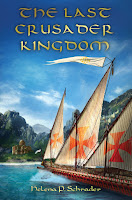
The Last Crusader Kingdom


"Encounter in a Tavern"
An Excerpt 

 In the stables, John first got Lord Aimery’s palfrey tacked up and then Centurion, while [his dog] Barry kept watch at the door warily. It seemed a long time before Lord Aimery loomed in the stable door, but he had their gear, and together they tied it on the pack horse. 
From the tavern came the sound of men grumbling and calling for their bills. “Closing time!” John whispered to Lord Aimery.

“They’ll all be coming out, then,” Lord Aimery drew the correct conclusion. “Hurry.”

John grabbed the lead of the pack horse and took Centurion by the bridle, while Lord Aimery took charge of his two horses. They made it out into the courtyard, but before they had a chance to mount, men spilled from the tavern into the yard.

“Mount!” Lord Aimery hissed at John, but before he could even get his foot in the stirrup one of the Greeks lunged at John, drawing a knife as he did so.

John saw the steel blade in the darkness and tried to jump aside, only to collide with the pack horse. He felt the blade hit his side and then slide over the rings of his hauberk. The man drew his arm back for a second strike as, with the clatter of hooves, Lord Aimery spurred forward, his sword raised. Most of the crowd fled to the safety of the building, but the attacker grabbed John by the throat of his hauberk with his left hand and swung him about, using John as his shield against Lord Aimery’s sword. John felt him draw back his right hand for a second stab. In his mind he registered that at this range his chain mail wouldn’t save him.

Suddenly his assailant was screaming in pain and terror as Barry sank his fangs deep into the man’s buttocks and dragged him away from John. Immediately Lord Aimery spurred past a dazed John and, leaning down from his saddle, swung his sword in a blow strong enough to nearly decapitate the would-be murderer.

As the man collapsed in a spume of his own blood, Lord Aimery turned his horse again, shouting to his still-dazed squire: “Mount!”

John turned, grabbed the near stirrup, and pulled himself up into the saddle. Lord Aimery spurred toward the exit to the stable yard with his destrier on the lead. Centurion leapt forward without awaiting any human instructions, and the pack horse followed out of habit. Barry brought up the rear at a lope, his tail in the air and his ears up -- as if he were enjoying himself for the first time since he’d acquired a new master.


Friday, January 12, 2018

"A Second Chance" - An Excerpt from "The Last Crusader Kingdom"

A major theme of "Envoy of Jerusalem" was the fate of Christian captives after Hattin or in subsequent defeats.  These men and women, who were enslaved by the Saracens, for the most part disappeared into a perpetual hell, but some were restored by ransom payments and the terms of treaties and truces.  Even if freed, these men had lost their possessions and families for the most part and they faced a precarious existence in the vulnerable states that clung to the Mediterranean following the Third Crusade. In this episode from "The Last Crusader Kingdom" we follow the fate of one such man.


The ringing of vespers marked the end of the twelve-hour day at last, and the men dropped whatever they were doing and lined up for their pay. Ayyub nodded his thanks to the clerk as he took the two dinars, and stashed them inside a purse tied to a cord inside his kaftan. He then hastened around the corner and up the street to a small square with a public fountain....Feeling somewhat restored [by a bath], although sore all over, he started up the street to the Cathedral of the Holy Cross. He had a plan, but it all depended on Master Moses.


On his release after the Treaty of Ramla, Master Moses―like thousands of other former slaves―had washed up in Tyre. In a city overrun with released captives, he was nothing special, just another ex-slave―and a crippled one at that. No one cared what he’d been before Hattin, and a man of forty-something with just one hand could not compete with hordes of healthier, younger men like Ayyub himself. He had ended up a beggar, and it was in this capacity that Ayyub and Moses had met again roughly a year earlier.

Since then Ayyub had made a point of sharing some of his earnings whenever he was lucky. That was rare enough, and Master Moses was visibly failing. He was permanently bent, skeletally thin, and often mentally absent as well. Ayyub was terrified the former master might be too far gone to help him now.

At least he was sitting in his usual spot, nestled into one of the niches formed by the receding arches of the main portal. He had a dirty rag spread out before him for people to drop coins into as they entered or departed. His unkempt mane of graying hair hung about his shoulders, but it had thinned so much that his scabby scalp showed through in many places. His wrinkled face was dirty and blank. He sat with his knees bent before him and his stump propped on them for all to see: a silent plea for alms.

“Master Moses!” Ayyub called as he reached the foot of the stairs up to the portal and started up them.

His former master’s head swung slowly and stared at Ayyub as he approached. He did not smile in pleasure; he just stared.

“Master Moses.” Ayyub went down on his heels in front of the beggar. “What would you say to working as a master builder again? To building aqueducts?”

“I’d say you’ve gone mad,” came the bitter answer.

“But could you do it? Could you design and build an aqueduct? Like we were going to do together?”

“Have you been drinking or chewing khat?” the master builder asked, narrowing his eyes and eying Ayyub suspiciously.

“Neither! I can’t afford such luxuries. The Baron of Ibelin is looking for a master builder to build aqueducts and sewage drains on Cyprus.”

“I’ve seen more sewage drains than I ever want to see the rest of my life!” the ex-slave growled. “Go away!”

“This isn’t about cleaning them out,” Ayyub protested frantically, his dreams collapsing around his ears. “It’s about designing them and watching other people build them.”

The beggar snorted skeptically and snarled, “What’s in it for you?”

“Just that you take me on as your apprentice, like before: that you take me with you.”

“Where?”

“To Cyprus! Didn’t I already say that? Ibelin wants a master builder willing to go with him to Cyprus.”

“That’s what you say!” Moses scoffed. “Sounds like a drunkard’s dream to me.”

“I’m not drunk. I’m stone-cold sober, and I heard the exchange myself. What’s the harm in trying?”

“Trying what?”

“Going to find the Baron of Ibelin and presenting yourself.”

Moses ibn Sa’id made a rude noise.

“Come with me!” Ayyub insisted, reaching out to pull Moses to his feet by his forearm.

Moses tried to shake him off, but Ayyub was stronger. “You’re coming with me,” Ayyub insisted.

Sunday, November 12, 2017

"Negotiations with the Devil" - An Excerpt from "The Last Crusader Kingdom"

The German philosopher Carl von Clausewitz rightly noted that war is the continuation of politics by "other" means. Likewise, when the political objectives of a conflict remain illusive -- or the price of conflict becomes too high -- most parties seek to resolve differences by non-violent means. At that point negotiations with "the enemy" -- whoever that may be -- become necessary, and compromise essential.


From the top of the escarpment, Sir Galvin and Ibelin’s other men watched anxiously. They shared Ibelin’s assessment of the sailors, and while they could not see Brother Zotikos’ eyes, they hardly needed to. His every gesture exuded hostility and aggression, so much so that [the dog] Barry lowered his head and curled his lips in a threatening stance. 
Sir Galvin glanced over his shoulder to Sir Sergios. The Maronite Syrian had served the Count of Tripoli at Hattin, but had been fighting under Ibelin’s banner ever since the great armed pilgrimage from the West that had wrested control of the coast back from Saladin. He was a superb archer, and he already had his bow out of its case. His quiver hung from the pommel of his saddle.

Sir Galvin nodded to him, and he fitted an arrow onto the string, lifted the bow, pulled the string back to his ear, and looked down the arrow with narrowed eyes at his target: the Greek monk’s broad chest. He nodded, then gently eased the string back to the uncocked position, yet kept the arrow notched. At this range, he was confident he could kill the Greek monk before he could do any harm to their lord.

None of Ibelin’s men could hear what was being said, but they could see the monk gesturing wildly with his arms. He threw them out wide, then rotated his right arm like a windmill. Then his hands formed fists that he held under Ibelin’s nose. A moment later he thrust out an index finger and jabbed the air in front of Ibelin’s face―eliciting an angry warning bark from Barry, whom John was visibly restraining from attacking.

Throughout it all, Ibelin appeared impassive. His stance was relaxed, his arms akimbo, his weight on his right leg with his left bent and slightly forward. His men recognized he was actually poised to swing his weight forward with his right fist if he needed to. Compared to the apparent flood of words that accompanied the dramatic gestures of the monk, Ibelin appeared to say very little. Once or twice he lifted his head as if to make a short remark. Each time his words provoked a new round of angry gestures from the monk, followed by increasingly violent gestures from Barry.

Once Father Andronikos tried to intervene, only to harvest a series of stabs with an index finger in his direction from the younger monk. John, meanwhile, was having trouble holding his dog, and was clearly distressed, confused, and a little frightened. He looked at his father for guidance, but the elder Ibelin remained calm, signaling for him to restrain the dog.

“I don’t think things are going well,” Sir Galvin observed generally, and Georgios shook his head sadly.

Abruptly, Ibelin turned his back on the monk and started back up the escarpment. The monk shouted furiously after him, making Georgios wince at the crude threat. Sir Galvin looked over, on the brink of asking for a translation, but then thought better of it. On the beach Father Andronikos was evidently trying to reason with the angry young monk, his hand on the latter’s arm. The younger man shook him off, and with a violent, dismissive gesture started striding toward his boat. The sailors were already shoving it back into the water; the stern floated while the bow remained on the sand, ready for Zotikos to re-board.

Ibelin reached the top of the escarpment slightly breathless from the climb, and held out his hand for his sword belt. “Hopeless!” he announced to his men, snatching the belt and wrapping it around his waist to buckle it snugly. “He insists that they will keep fighting until we are either driven from the island like the Templars, or all dead.” He grabbed the reins of his stallion, threw them back over the horse’s head, and gathered them up as he pointed his toe in the stirrup to haul himself into the saddle.

He was so agitated that he swung his horse around and started to ride off before John had had a chance to mount. Then he caught himself and waited, his expression grim.

“So they wouldn’t consider exchanging the abbot for Toron?” Sir Galvin asked, puzzled and disbelieving.

“No. That monk is a fanatic. He is incapable of compromise or negotiation. Saladin was pure reason compared to him!”