
A Guest Post from Michelle Foltz
Michelle recently returned from Lebanon, where she visited several sites from the crusader era. She agreed to share her findings with readers of my blog.
 |
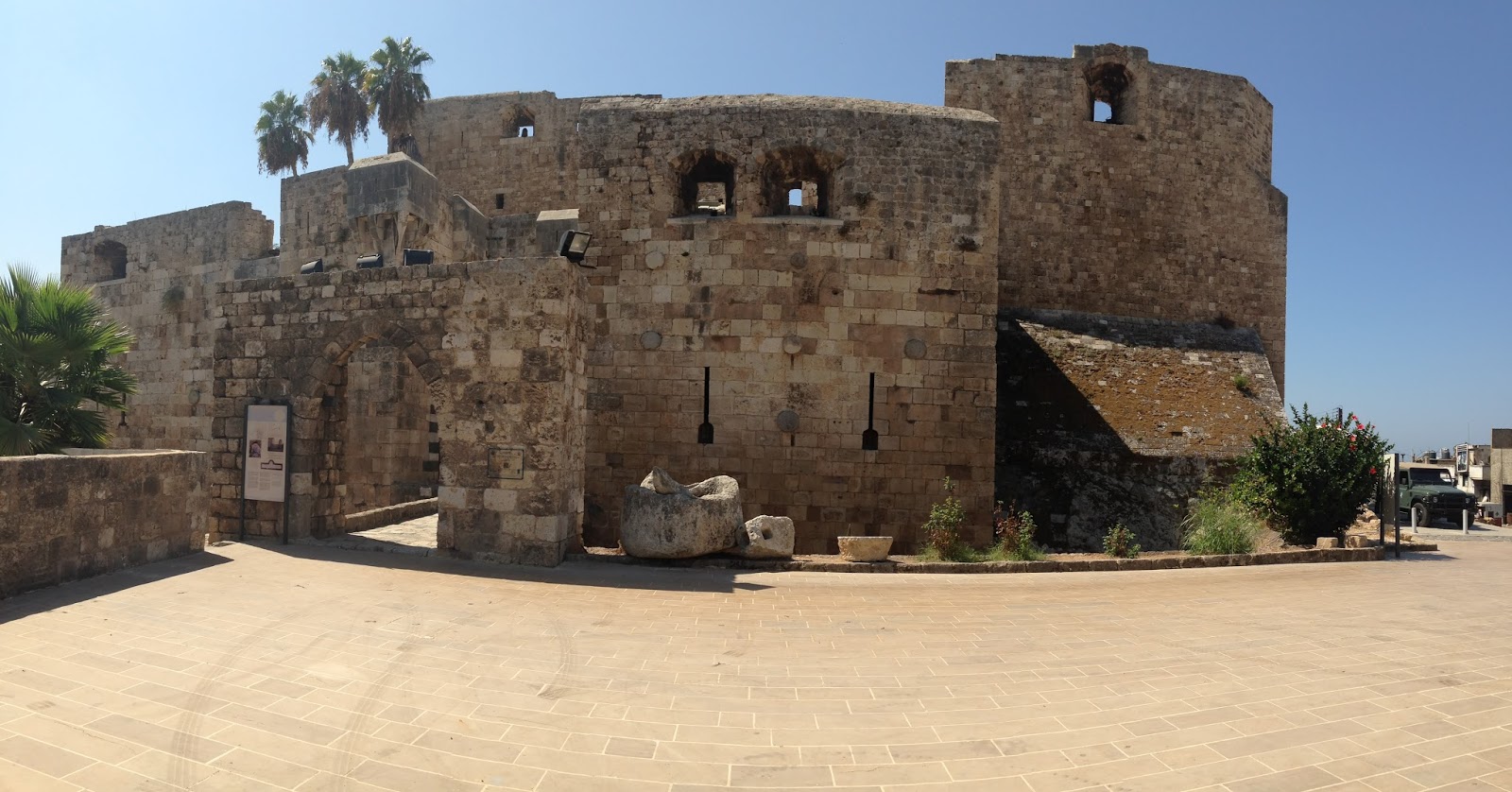
| Citadel of Count Raymond of Saint Gilles (copyright M.Foltz) |
Tripoli
The Citadel of Count Raymond of Saint
Gilles (Qalʿat Sanjīl ) deserves
top billing of the Crusader sites in the city of Tripoli if only for its
powerful, physical presence. Historically it was the site of important military
and administrative functions for every conqueror and defender of the area—from
the southern French Crusaders in the early 12th C to the Ottomans in the 20th.
The Citadel’s function as a defensive structure was destroyed during the Mamluk
conquest in the late 13th century and the ruins left unoccupied for the next 20
years before it was rehabilitated and expanded. Despite this history, the façade
of the Citadel has the external appearance and majestic proportions to kindle
the desire of any pilgrim on the ‘Crusader Trail’ to claim it as wholly
crusader.
Today it is difficult to identify the exact demarcations of the original
structure as old stones have been recycled in successive rebuildings. Medieval
ashlar of the earliest construction could have been refashioned and used for
the top level of the parapets centuries
after it was originally quarried, laid, and torn down. One notices rocks
of different sizes and shapes to those on either side or in adjacent courses or
as arches filled-in or half obliterated.
This is most noticeable at the corners and interfaces of walls,
typifying the various styles and changing functions over the centuries.
However, experts of medieval architecture write that the foundations show
distinctive features of southern French or Provençal heritage, the home of San
Gilles and his followers, the original, Crusader builders.
 |
| Tripoli - Northern Gate to the Citadel (copyright M.Foltz) |
Most of the extant interior walls and
terraces were built during Ottoman times
for military and administrative functions. The prison, barracks, store rooms,
and stables are well identified in the posted explanations. The most
identifiable internal crusader structure is the rectangular outline of the
Church of the Holy Sepulcher of Mont-Pilgrim that the San Gilles rulers built
over a pre-existing Shia’a saint’s mausoleum.
This Muslim holy place was said to remind Count Raymond of the Church of
the Holy Sepulcher in Jerusalem, the liberation of which had been the primary
focus of the First Crusade. A partially intact engaged column and pier that
formed one of the arches that supported the missing barrel vault of the Romanesque church is the only distinctive Christian remains in the interior.
 |
| Crusader Column in the Chapel of the Citadel, Tripoli (copyright M.Foltz) |
Two museums are housed within the
Citadel. One concerns the history of the Citadel itself. The other, in the
long, gracefully vaulted Ottoman barracks, contains historical objects and
information concerning a number of archeological sites in northern Lebanon. The
official ticket seller/guardian must be specifically asked to open this latter
museum and seemed to have little tolerance for an extended visit. Both are well
worth a thorough perusal.
 |
| Inside the Citadel in Tripoli (Copyright M. Foltz) |
The Citadel sits in the center of
modern Tripoli overlooking the present day souks and the city west to the
Mediterranean Sea. In 1102 and until the early 20th C the Citadel lay well
beyond the city’s boundaries, whose center was the port, Al-Mina, on the peninsula. Before capture by the crusaders,
the 11th C city was famous as a center for culture and learning and was ruled
by the Shia’a Banu Ammar family who held close ties with the Fatimids in
Egypt.
Count Raymond built the Citadel
three kms from the coastal city walls, on a ridge near a bridge on the Abu Ali River and called it Mount Pilgrim, Mons
Peregrinus. From this position he began besieging the city while
controlling access to the town from Damascus, Homs, and Aleppo. Despite this
advantageous position, it took the combined Crusader armies, seven years, and
the help of Provençal and Genoese fleets before the city was secured
and the County of Tripoli established as the fourth Crusader state.* The
counts ruled from the city, leaving the Citadel as an outer defensive bastion. In the mid 12th C. it was given to the
Hospitaller knights who used it, along with the great fortress of Krac des
Chevaliers and a surrounding network of smaller forts, to solidify their
growing political, economic, and defensive role in the County.
 |
| Krak des Chevaliers (copyright HSchrader) |
Standing on the Citadel’s ramparts and
looking west to the sea individual domes, minarets, and khans are identifiable from the mass of structures below.
A bit of imagination can convert the area between the souks and the port of
Al-Mina into the extensive orange and olive groves that once dominated this
open space before it was filled-in during 20th century expansion.
To a ‘western
eye’, one of the most distinctive buildings is the square plan Romanesque
minaret of the Grand Mosque that would not be out of place at the summit of a
Lombard hill town. It was once the bell
tower for the medieval Church of St. Mary.
History is filled with conquerors destroying or desecrating the religious shrines of their
enemies. History is also filled with conquerors re-purposing or incorporating
the religious structures of their enemies into a different context—religious or
other—involving a major refashioning to alter the existing orientation. The
minaret of Tripoli’s Grand Mosque is at the extreme end of accepting the whole
cloth of a religious structure without alteration. Nothing hides its Frankish
origins; only a simple crescent filial converts its religion, but not its
function.
 |
| Tripoli Grand Mosque with Minaret like an Italian Church Bell Tower (copyright M.Foltz) |
The site of Tripoli’s souks were once
the center of the commercial and
residential city that grew up around the Citadel after the Mamluk conquest.
Before that, it was the small crusader village of Mount Pilgrim. The present
day souks are primarily Mamluk in layout with Ottoman layers and very few Crusader
remains. The Ezzedine Hammam was once a medieval church, and it was still possible to decipher the Christian iconography of lamb and
scallop shell at its entrance. The columns gracing the khan of the tailors,
Khan al-Khayyatin, have all the appearance and orientation to have once graced
a Byzantine chapel. Perhaps the covered Souk al-Haraj, with its evocative
columns, had a function in the 12th C medieval village and before that a Roman
temple? Little is specifically known or readily available to answer.
The main avenues of the souks give off
numbers of narrow alleys and side streets that twist, intersect with each
other, and turn, acting as defensive
elements as they ascend and traverse the slope to the Citadel. Many dead end,
some into small courtyards planted with fruit trees and flowers. The alleys are
cool and narrow; the small, high windows with their latticed window
projections, mashrabyias, allow those inside a ready view to the outside, while
protecting the interior privacy. For a first trip into the souks, a good guide
can lay the ground work of the past that can be fleshed out on subsequent
independent visits.
Al-Mina, the present port, was the
center from which the Counts of Tripoli administered their lands and the
Italian commercial city-states ran their warehouses and trading emporiums. The
Mamluks thoroughly destroyed this area and did not rebuild or settle in it for
fear of the fleets of the Frankish rulers of Cyprus, however, it continued to
be an important port connecting Europe with both Aleppo and Damascus. No Mamluk
religious buildings, such as those around the Citadel and the souks, are found
in Al-Mina. Even the great Ottoman era walls have been torn down or built over.
Though nothing standing is Crusader, the Romanesque architecture of the 18th C
Saint George’s Orthodox Cathedral shows robust Byzantine and medieval
influence, while a cave below the church dates as a religious structure from
long before even the 12th C.
Smar Jbeil Fortress and Town
 |
| Smar Jbeil with the Author Michelle Foltz (Copyright M. Foltz) |
Unmentioned in guidebooks and little
known to those outside the area as a Crusader site, information about Smar
Jbeil is available on the Internet with various levels of accuracy. Until the
Syrian army left their position in the fortress, it was not readily accessible,
but since 2005 the community and the Lebanese Director General of Antiquities
have worked to restore and rebuild the site.
The village and the fortress of Smar
Jbeil share a history dating from at least the 3rd millennium BCE. The Phoenicians probably gave the area its name, meaning
guardian or watchman over Jbeil, the important Phoenician coastal city (aka
Byblos). In the 6th BCE the area came
under control of the Persians, falling to the armies of Alexander in the 4th. The Romans and later the Byzantines held sway
after Pompey’s conquests in the mid first century BCE. Though defensive in position and structure it
is thought that the Romans used it as a governmental, administrative
residence. In the 7th C CE, Mar Jean Maron, the first Maronite Patriarch, lived in
the fort, turning like many of his followers to the safety of the mountains
from persecutions by the Orthodox in the coastal urban areas.
The strategically lofty position of
the hill top, 500 meters ASL,
makes it reasonable that it was used in one form or another for defense, most
likely for observation and communication purposes by all the peoples who at one
time or another ruled the area. The repeated statement highlighted on the
Internet, reports that a defender on the ramparts would be able to scan the
Mediterranean coast from Jbeil (some sources say Jounieh) to Tripoli, some 45
kilometers in length. I could not positively identify either city on a clear
morning. Still the view is gloriously impressive and knowing that most military
and commercial sea travel would have rarely deviated from coastal routes, the
strategic value of the fort is incontestable.
Like
the crusader fortress of Qa’alat Saladin in nearby Syria and Kerak in
Jordan, Smar Jbeil is built into, on, and within a great mass of bedrock, giving it an
inherent strength and sense of solid defensibility. Though extremely modest in area compared to
the better known medieval citadels in the Levant, it has a serene majesty of
purpose for which size is of little standing. The impressive vistas to the
Qadisha Valley and Bacharré to the east and northeast are as
commanding as the ten km. view down to the sea.
 |
| Water Troughs carved out of Bedrock at Smar Jbail. (Copyright M. Foltz) |
Smar Jbeil is recorded as part of the
crusader fief of Saint Montagne of the lords of Batroun who were vassals to
the Counts of Tripoli. Some sources
state that "the Franj" (crusaders) demolished the old castle to build a new one, calling it Chateau
Fort, Strong Castle. The moat, excavated through solid rock, the enclosing
wall of the fort punctuated with defensive towers, the separate, central
smoothly bossed donjon, and the postern exits are all architectural elements,
that along with the style and quality of the stone work, attest to crusader
influence. Smar Jbeil’s strategic
position along with evidence of previous fortifications and the Frankish
pattern of building defensive networks of outlying fortifications give credence
to the importance this site holds for crusader history.
The remains of interior structures:
olive oil and/or wine presses, Roman tombs, tombs with Greek inscriptions,
several hundred wells carved into the surrounding rocks, tunnels, and some
indistinct bas reliefs on the northern side of the bed rock testify that the
fort provided administrative and economic functions that were probably well
coordinated with those in the town. Walking along the moat and around and
through the defensive walls, however, there is no question this was first and
foremost a significant defensive structure.
The churches of Smar Jbeil have a
place in history equal to the fortress. The earliest Christian church to Mary
in Lebanon (Al Sayde, Our Lady of Gifts, or Our Lady of Rescues) built in the 6th C, sits less than a hundred meters down
the slope from the fortress. It stands,
a poetically ruinous but spiritually compelling single nave with semicircular
apse. Its south wall has been broached by the growing trunk of a thousand year
old Lebanese oak whose branches arch to form a roof and whose brown leaves and
acorns breeze across the floor in a moving carpet. The gently dappled en
plein air ambiance enhances the tranquillity of this historical gem. The
church was desecrated during the recent Syrian military occupation but has been
rehabilitated by the townspeople and is being evaluated for expert
restoration. It remains in service today
as a venue for baptisms and weddings.
 |
| Our Lady of Gifts Chapel in Smar Jbail |
Immediately beside the Church to Our
Lady of Gifts is the main Maronite Church of
Saints Bassil and Nouhra. By history an earlier church existed on the
ruins of a much older Roman temple during Roman and Byzantine time. Cut rounds
of recycled columns are among the ashlar courses making up the eastern wall.
Major renovation by the crusaders in the 12th C was followed by various
additions needed to counter wear and nature. By tradition Saint Nouhra came to
Batroun from Egypt in the 4th C. When commanded to give up preaching his
religion, he refused, was tortured and blinded, but miraculously continued to
see, and was buried in one of the wells of the fortress. The water from this
well became known for curing blindness and other diseases of sight. Nouhra is
Syriac for light.
The church is a square divided by four
piers that support the resulting nine vaults with three alters at the east end
to Bassil, Nouhra, and Mary. The walls and piers are plastered white with
narrow tracings in the groins and other edges in blue and brown. Plaster molds
on the piers of pairs of doves drinking
from a chalice and other Christian motifs are in keeping with the uncluttered,
open, clean space. The south wall, from the Byzantine era of construction,
incorporates two columns that are associated with stylites—hermits or
anchorites who sought God’s presence by standing for years on pillars. The
western entrance and porch with 3 bays of unplastered vaulting is crusader in
origin. An unusual carving graces the south portal from the porch that looks to
be an unconventional dragon-fish, its symbolism unknown. The entrance on the north
side of the church was redone in late Ottoman times. Draped above this entrance
is a chain carved from a single block of stone, similar to the one found at the
Hammam al-Jadid at the entrance to the souks in Tripoli.

The rehabilitation of the fortress and
the chapel to Our Lady in Smar Jbeil is a striking example of what a community
can accomplish when it works together to care for and honor its heritage. This
is in sharp contrast to the attitude in Tripoli where a perverse pride of
ignorance of the town’s history seems the norm. People boasted of never having
visited the Citadel. Perhaps there is too much history to sort out, or the
history doesn’t fit with present nationalistic ideals.
* The other three: County of Edessa,
Principality of Antioch, and Kingdom of Jerusalem
The Jerusalem Trilogy is set in the crusader period.


