Helena Schrader's Historical Fiction

For a complete list of my books and awards see: http://helenapschrader.com

For readers tired of clichés and cartoons, award-winning novelist Helena P. Schrader offers nuanced insight into historical events and figures based on sound research and an understanding of human nature. Her complex and engaging characters bring history back to life as a means to better understand ourselves.

Saturday, September 17, 2011

First Reviews of Leonidas of Sparta: A Peerless Peer

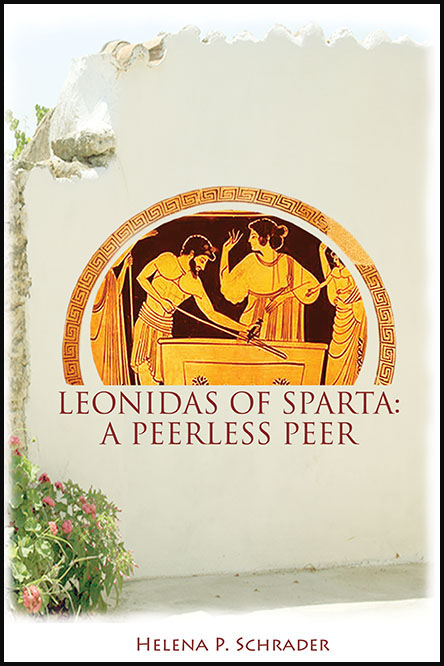
Just ten days after the release of Leonidas of Sparta: A Peerless Peer two reviews have already been posted on amazon.com. That's exciting -- especially when both are from people I do not know and to whom I did not send review copies. I hope this is a good omen and the book will continue to attract positive attention.

5.0 out of 5 stars
So Good It Will Make You Stay Up Past Your Bedtime..., September 8, 2011
By
Kathleen Ann Langley "Lucky 7 Tattoo Kings Beach" (Lake Tahoe, California)
(REAL NAME), Amazon Verified Purchase

This review is for: Leonidas of Sparta: A Peerless Peer (Paperback)

Yes, once again Ms Schrader has kept me up WAY past my bedtime for "just one more chapter." Rarely in historical fiction does this happen for me. I will hit a boring spot in a book and easily put it down until next time. Not so with the second book of this Leonidas trilogy "Leonidas of Sparta: A Peerless Peer." She had a tough job to outshine herself after the first part of this 3 part series, " A Boy of the Agoge" yet the author met the challenge with gusto.

All the main players of ancient Sparta are back, and some new ones add to the story without becoming confusing. Gorgo comes into her teenage years with timeless problems we can relate to. Leonidas becomes a man we would all desire to have in our lives as the ultimate compassionate alpha male. And the folks who surround these 2 ancient royal players have their own stories told too. Not a boring one in the bunch either. It's like a soap opera set in antiquity!

Now that I have plowed my way through this second book I once again cannot wait until the 3rd and final book comes out next year! If you even have a vague interest in what life may have been like for Leonidas, or the Spartan people at this time and place in history, you will dig this book.

AND
5.0 out of 5 stars
Thin rations, September 4, 2011,
BY
Jessica Allan Schmidt (People's Republic of Cambridge, Massachusetts, United States)
(REAL NAME)

This review is for: Leonidas of Sparta: A Peerless Peer (Paperback)

William Styron, author of The Confessions of Nat Turner once commented that a historical novelist did best when given "thin rations". This book takes those scant rations available from the historical record and extrapolates them, using common sense as well as classical sources, to construct what life may have been like for Leonidas I. There are some interesting inconsistencies with the historical records -- for instance, it is not known if Cleombrotus was Leonidas' twin or younger brother, yet the series paints him quite convincingly as Leonidas' elder twin -- but on the whole, it provides a very interesting look at the dynamics of an unusual society.

Sparta is often treated by modern scholars as a nation of simple brutes, but records do not hold with this -- if the training of youths was simply a matter of testing them until they broke, Greek leaders from all over the peninsula would not have competed to send their sons to the agoge for whatever periods they could. Like military schools of today, Sparta's educational programme was much more clearly devoted to military *and* practical learning, but the relative dearth of universal military training during this period means that its military nature is over-emphasised. Moreover, the fact that attendance at the Spartan agoge meant for some préstige among other Greeks strongly implies that it was seen as a specialist school that was a great honour for youths inclined to eventually rise to rôles of command in their own city-state's military.

The examination of what Spartan adult life was like is an interesting view of comparison and contrast. In the era before supertankers and jet aircraft, military engagements were by necessity no more than half the year, before mud and rain made it impossible to manoeuvre effectively, and, even more importantly, avoid disease decimating the ranks (a killer that was more likely than death by battle wound up through the Second World War), and therefore, even though Spartans were certainly careful to keep themselves in training year round and maintain constant operational readiness, they also had personal, civilian lives that were just as important to them, if not more so. As any tactician can tell you, the most motivated fighter is one who fights to defend a society he feels is integral to his life. Were Sparta a brutal place dedicated to warfare and only warfare, there would be no society to defend.

In this book, it is interesting to see the evolution of Queen Gorgo from girlhood to womanhood, even though most of it is conjecture based on what *is* known of the training of Spartan women. This book is also surprisingly engaging for the middle part of a trilogy, traditionally a time when *any* storytelling lags. The agoge is notorious, and Leonidas' death is equally well-known, but this period could have been fairly dull, yet it is as engaging as the first book in this series. I recommend it strongly.


Saturday, September 10, 2011

Where Eagles Never Flew: Excerpt 1

Dear Followers,

To whet your appetite for Where Eagles Never Flew I will be posting here excerpts from "Eagles" for the next several weeks.

Priestman unhooked his oxygen mask and shoved the hood back before he landed, gulping in the fresh air. When he set down on three points, he thought he had never in his life been so glad to have ground under him.  He was aware of a pulsing headache and his eyes felt swollen in their sockets. He taxied absently to the side of the field, too tired to notice if someone was signalling him someplace else. He cut the engine, pulled off his helmet, and ran his hand through his hair -- it was wet and sticky.

He heard someone pant up beside him. "Robin?"

He glanced over; it was Roger Ibbotsholm.

"Aye, aye." Robin was having trouble unclipping his straps for some reason.  Roger was on the wing and bent over to help him.

"Are we glad to see you! We thought you'd bought it!"

"They did rather catch us out -- again. Is everyone else back?"

"The CO's gone for six. Flamed out and went straight in from 10,000. Guy had to hit the silk over Seclin.  Driver swears he saw a parachute land just beside the field so he's almost certainly a POW. Shakespeare says Spotty didn't make it either -- crate flamed before he could get out."

O'Brian and Sellers reached Priestman. They too were panting, having run over from the far side of the field. "Are you all right, sir?"

"I've got a terrible headache, actually," Robin admitted, rubbing his frehead.

"There's a ruddy big hole in the back of your seat, sir!"

"Oh, that. Yes. Good thing about the armor plating."

"You can say that again, sir! Look!"

A crowd was gathering. This Hurricane didn't look nearly as tattered as his old one, but the one neat puncture it did have indicated a cannon shell had lodged deep in the armour plating behind his seat.  The others scrambled up the off wing and peered into his Hurricane. There were a lot of admiring whistles and excited comments. Priestman left the others to it and slid to the ground, leaning back against the trailing edge of the wing.

Only once before had he been so conscious of divine protection -- after capsizing a small boat in a Force Five gale in the Solent. Then he had been a foolish 15-year-old boy who over-estimated his abilities, and for whom a benign deity had no doubt felt pity. Today, with so many others dead, it was hard to understand why he should have been one of the lucky ones.

An airman appeared around the tail and offered him a cup of cocoa. It was almost cold, but Priestman sipped it graefully.

Priestman noticed Yardly approaching but didn't think anything of it -- until the Flight Lieutenant opened his mouth and said: "I'm acting CO now, if you're wondering." Robin hadn't gotten that far, actually, but he didn't like the sound of this. Priestman had never really warmed to Sharp, but he was a first-rate pilot and a conscientious commmander. Priestman had trusted him. Yardly was something else agian. From the day he joined the squadron, Yardly had seemed to resent him. In short, this was not a good development.

Yardly, meanwhile, was remarking, "I see you were lucky a second time, Priestman."

"Yes, sir." It obviously did not occur to the senior officer that maybe this pilot was particularly skilled or a talented dog-fighter.

"And the Blenheims got slaughtered again." The Flight Lieutenant made it sound as if it was Priestman's fault alone. Priestman kept his mouth shut. He might do stupid things when he got backed into a bad enough corner, but he wasn't inherently insubordinate or stupid.

Yaredly was compelled to continue his lecture without new fuel. "Our job is to protect our bombers, not go rushing off on our own. Don't forget it! I'm not going to put up with your nonsense the way Sharp did."

What nonsense? Priestman asked himself. He'd been behaving himself like a damned goody-two-shoes since he'd joined the Squadron!

(This excerpt is from Chapter 1 of Chasing the Wind, soon to be released in Kindle format under the new title Where Eagles Never Flew.)

Saturday, September 3, 2011

Thank You! and now "A Peerless Peer..."

Dear Followers,

Thank you for participating in my three surveys on the title, subtitle and cover image for the Kindle Edition of Chasing the Wind. There was considerable concensus that the best title is "Where Eagles Never Flew" -- although one or two of you confided in me well-founded reservations. After consulting with the publisher, however, the decision was made to go ahead with Where Eagles Never Flew as the title for the Kindle book.

Although the largest number of readers preferred the longest suggested subtitle, the publisher and cover designer vetoed this for practical reasons. The cover of a Kindle book never appears as anything more than a "thumbnail" and space is therefore at a premium. The publisher felt that we couldn't afford to spend so much "real estate" on the sub-title -- which would probably be almost illegible on a thumbnail anyway. So we opted for the shortest of all sub-titles: "A Battle of Britain Novel."

The cover was also a close call, with a slight plurality in favor of Cover 1. I have asked the designer to look at ways of combining the key features of these two covers and come up with a new design that meets the publisher's preferences but includes some of the features of Cover 1 that (from talking to some of you) was the main appeal of this design. 

Otherwise, all is on track for the release of Where Eagles Never Flew in about 3 weeks time. I will be sure to post information about the release on this blog. 

Leonidas of Sparta: A Peerless PeerMeanwhile, the second book in the Leonidas Trilogy, Leonidas of Sparta: A Peerless Peer is available for purchase on amazon.com in both trade paperback and Kindle formats. For more information about the Leonidas Trilogy you can also go to the dedicated website: http://sparta-leonidas-gorgo.com/


Sunday, August 28, 2011

Help Me Select a Cover

OK. Thanks everyone for your contributions with respect to the title and subtitle!

It looks like "Where Eagles Never Flew" has won hands down for the title, but the sub-title is still undecided. If you have not yet voted, please take a moment to let me know what you think.

Meanwhile, I have three cover designs in contention, and I'd appreciate your views. Please vote for one only in this survery.

Thank you!

Helena

Saturday, August 20, 2011

Help Me Choose a Subtitle!


Last week I asked your help in finding a new title for Chasing the Wind, my Battle of Britain novel, which will soon be released in Kindle format. So far Where Eagles Never Flew is leading by a wide margin. Meanwhile, I want to focus on the subtitle.

Chasing the Wind: A Story of British and German Pilots in the Battle of Britain

A subtitle is particularly important for a book being released in Kindle format because the subtitle provides the key words that will be fed to the search engines. My publisher and I agree that the phrase "Battle of Britain" MUST appear in the subtitle -- as this is the most frequently used search phrase likely to draw prospective readers to the novel.

Another consideration when selecting a subtitle is that it has to fit on the cover. A subtitle that is too long runs the risk of cluttering the cover and detracting from the over all image and so attractiveness.

You may have noted that the two considerations conflict. For the first, more words is better, for the second, less is more.

But that is why I want your help!

Please take a moment to particpate in my survey. Note that for subtitle you may vote more than once.

Thank you!

Helena

Saturday, August 13, 2011

Help Me Choose a New Title!

Dear Followers and Friends,

Chasing the Wind: A Story of British and German Pilots in the Battle of BritainMy Battle of Britain novel, Chasing the Wind, is going to be released in Kindle format.  However, since the original release, more than a dozen other books have been published under the same title. This led me (and my new publisher Wheatmark) to decide it was time to change the title -- and the cover image.  We'd like your help!  Please help us by taking part in the surveys I will be posting here over the next three weeks. Vote for the title, sub-title and cover you like best.

This week the survey is for the main title only.

The original title, Chasing the Wind, was inspired by the poem "High Flight" written by John Gillespie Magee, Jr., an American fighter pilot in the RAF during WWII.  Magee flew Spitfires. He was killed in 1941, aged 19. 

For those of you unfamiliar with the poem here it is:

Oh! I have slipped the surly bonds of Earth
And danced the skies on laughter-silvered wings;
Sunward I've climbed, and joined the tumbling mirth
Of sun-split clouds, -- and done a hundred things
You have not dreamed of -- wheeled and soared and swung
High in the sunlit silence. Hov'ring there,
I've chased the shouting wind along, and flung
My eager craft through footless halls of air...

Up, up the long, delirious burning blue
I've topped the wind-swept heights with easy grace
Where never lark, or ever eagle flew --
And, while with silent, lifting mind I've trod
The high untrespassed sanctity of space,
Put out my hand, and touched the face of God.

The new title will also be derived from this classic aviation poem, paraphrasing the third line of the second stanza, but we're undecided on exactly which phrase works best. You votes are very important to us, so I hope you'll take the time to take part in the survey.

Thank you!

Helena

Saturday, August 6, 2011

A Cavalry Officer on the Road to Calvary: Philipp Baron von Boeselager

An Obsolete Honor: A Story of the German Resistance to HitlerI would like to end my four part series about the real people who inspired and influenced my novel An Obsolete Honor (soon to be released in Kindle as Hitler's Demons) by telling the story of Philipp Baron von Boeselager. I first met Philipp at an official reception hosted by the German President on July 20 to honor the Resistance. As a lone American, a mere graduate student working on a PhD, I felt rather lost in the exalted company and found myself looking about shyly for a place to sit. Baron von Boeselager spotted me, got up from his table, came over and bowed slightly before inviting me to join him and his wife at their table. He had never met me before in his life, and his gesture was that of the consumate gentlemen he was until his death.

Like Axel and Marion, Philipp Baron von Boeselager made no claim to be a hero – despite his Knight’s Cross and other lesser decorations for bravery he had received during the war. Others have begged to differ. Philipp von Boeselager is possibly the only recipient of Hitler’s Knight’s Cross, who is also an Officer of the French Legion of Honor. The latter was awarded him in 2004 in recognition of his role in the coup d’etat against Hitler on July 20th 1944. Boeselager, accepted the honor “for those who are no longer with us.” Boeselager provided me with unusual insight into the Wehrmacht and its command apparatus.

In the winter of 1941 Philipp Baron von Boeselager was severely wounded on the Eastern Front. Following a stomach wound, he could only walk with crutches and had extreme pain which he could only master with morphine. Nevertheless, he was deemed fit for staff work and asked whether he would be willing to serve as aide (Ordonnanzoffizier) to Feldmarschall von Kluge, then commanding Army Group Center on the Eastern Front. Just before the train pulled into Smolesk, Russia, where the headquarters of Army Group Center was located, Boeselager threw his crutches out the window. He feared that if he reported to his new superior on crutches, that the Field Marshal would send him home again as unfit for duty. He continued to take morphine until the end of the war.

The staff at Army Group Center was dominated by the First General Staff Officer, Henning von Tresckow, and Tresckow had turned the staff of Army Group Center into a nest of opposition to Hitler. Tresckow had been a witness to the slaughter of the Jewish population of Babi Yar by SS Special Units (Einsatzkommandos). By the time Boeselager joined the staff of Army Group Center, Tresckow was already working closely with two other nerve centers of military resistance in Berlin, the General Army Office under General Friedrich Olbricht, and Military Counter Intelligence under Admiral Canaris. Olbricht had already developed the blue-print for a coup, disguised as an official plan for suppressing domestic unrest, Plan Valkyrie. Meanwhile, Canaris’ right-hand man, Hans Oster, was working on finding a means and opportunity to assassinate Hitler. Tresckow’s role was to get his superior, Field Marshal von Kluge, on board the conspiracy, and so provide the conspirators with fighting troops with which to put down any counter-revolt by SS troops loyal to the Nazis.

Kluge had been an opponent of Hitler since before the war. He had been part of the coup plans against Hitler in 1938. He was also a first class general. It was his 4th Army that had broken through the ostensibly impassable Ardennes and so turned the French Maginot Line, and it was his Army that cut off the British Expeditionary Force with its back to the sea just weeks after the start of the Western offensive in 1940. It is an irony that the name of one of his subordinate divisional commanders, Erwin Rommel, is more famous today.

When Boeselager joined Kluge’s staff, Kluge was more disillusioned with Hitler than ever before – but he was not yet ready to move from opposition to resistance, from criticism to treason. As the situation on the Eastern Front deteriorated, Boeselager became a first-hand witness of Kluge’s cruel dilemma as Hitler’s Field Marshal.

One of the duties of a field marshal’s aide was to listen to every official telephone conversation that the field marshal conducted. Thus Boeselager heard everything Kluge said to his subordinate Army Commanders – and every talk with Hitler. Boeselager remembered vividly the way Hitler would manipulate conversations and confuse matters. He remembered the absurdity of Hilter – the Commander-in-Chief of millions of troops – ordering the re-location of individual battalions. He remembered that Hitler would try to distract Kluge from a specific request by talking at length in rambling language about his strategic plans for conquering India – or change the subject by saying something like, “Oh, and by the way, I have allowed myself to send roses to your gracious wife on the occasion of her birthday.”

Boeselager’s duties also took him to Hitler’s headquarters, where on occasion he was included in the inner circle. Boeselager personally witnessed the fact that in a small circle Hitler could be a witty and amusing conversationalist. Boeselager told me that at one dinner he was practically convulsed laughter, although he later could not remember exactly what the dictator had said. Nor did the incident in anyway change his abhorrence of man.

At least once, Boeselager’s inability to disguise his contempt for Hitler’s entourage got him arrested. On this occasion, Kluge was closeted with Hitler and other senior officers and Boeselager was left to take a meal with Martin Bormann and others of Hitler’s personal staff. Boeselager had flown in from the front with Kluge to plead for the right to pull back 100,000s of troops in danger of being cut off in a “mini-Stalingrad.” He could hardly eat for worry about what was happening on the front, but Hitler’s staff was complaining about the lack of fresh strawberries! Boeselager couldn’t contain himself. He told Bormann what he thought of him, and the next thing he knew he was locked in a small chamber with a guard posted outside. Kluge found him there and with a rhetorical “What are you doing here?” got him out. But Kluge also warned his aide that next time “he might not be so lucky.”

On another occasion, Boeselager overheard a conversation in which Hitler’s entourage discussed the fact that “once they were finished with the Jews” they would “go for the Catholics.” Boeselager interrupted immediately and told them that they could start with him. Bormann dismissed the objection, saying, “Recipients of the Knight’s Cross would be exempted from extermination.” A response, which did nothing to reduce Boeselager's loathing of Hitler and his minions.

Boeselager was also a witness to Kluge’s honest, tenacious and sometimes desperate attempts to get Hitler to allow Army Group Center to withdraw and re-group as the pressure from the Red Army became overwhelming. To no avail. By March 1943, Kluge could take no more. He agreed to join the conspiracy against Hitler – on the condition that Hitler was killed. Kluge argued that unless Hitler was dead, most officers would remain true to their personal oath to Hitler and there would be civil war. He approved a plan developed by his staff to shoot Adolf Hitler in a collective assassination attempt when Hitler visited Army Group Center Headquarters in Smolensk.

The plans were made. The location set: the Officer’s Mess of Army Group Center. The date: March 13, 1943. Hitler came to Smolesk, he ate in the Mess surrounded by officers determined to eliminate him, and nothing happened. At the last minute, Kluge apparently lost his nerve. Boeselager believes that the Field Marshal did not want to go down in history as a murderer and traitor.

But there is another explanation. As Hitler left Smolensk that day, Tresckow smuggled a bomb into his aircraft with the 30-minute fuse already running. If the bomb had detonated, Hitler’s aircraft would have gone down over partisan-infested territory. Plan Valkyrie would have gone into effect and the Army would have taken control of Germany's military and government apparatus before the wreckage of the plane could even be recovered. The British explosives used in the bomb would have suggested a foreign plot, and the conspirators would have been given a chance to consolidate power. In short, this means of killing Hitler was far superior to a joint pistol attack that instantly incriminated the German Army in the assassination. Is it possible that Tresckow informed Kluge of this option, and this was the real reason Kluge told his officers not to shoot? We will never know. But Boeselager had had enough staff work. He asked for and received a transfer back to the troops, to his beloved cavalry.

When July 1944 came, Philipp was commanding a cavalry regiment on the Eastern Front. His brother Georg commanded the cavalry brigade to which his regiment was attached and was working closely with Tresckow, who was now Chief of Staff of the 2nd Army. Tresckow knew about Count Stauffenberg’s plans to carry out the assassination against Hilter himself, and Georg Baron von Boeselager passed the word to Philipp. Philipp was ordered – by the conspiracy, not his military superiors – to re-deploy a 1,200-man cavalry task-force composed of six squadrons to Berlin to protect the post-Hitler government that would take power after the coup on July 20.

On 18 July 1944, Boeselager set the plan in motion. One thousand two hundred cavalrymen were withdrawn from their positions on the front and given orders to ride west toward a rendezvous point where they would transfer to motorized transport which would then take them to an airfield. Only a few of the cavalry officers knew what they were doing, but the troops trusted Boeselager implicitly and Boeselager did not act irresponsibly. Wherever he withdrew his selected squadrons, he ensured that sufficient troops remained behind to hold the front against the Red Army. Philipp himself stayed behind at his HQ as long as possible, and only at the last minute boarded a staff car to catch up with his troops, whom he reached on the evening of 19 July 1944.

His troops had now been riding for 36 hours straight. Philipp mounted and rode with his men. As the cavalry rode through the second night, some of the men were so exhausted they fell asleep even at a trot; some fell right out of their saddles and had to be helped back on their horses by their comrades. At three am, the cavalry task-force finally reached the rendezvous point with motorized transport and embarked.

Before they reached the airfield, however, a messenger from Georg Boeselager overtook them: Return to Base. Georg Boeselager had learned what many of the conspirators in Berlin didn't know yet: Stauffenberg had failed. The bomb he set off in Hitler’s HQ detonated – but failed to kill the dictator. With Hitler alive, the Nazi apparatus was still intact, and counter-orders, countermanding all the coup instructions, were already going out to all the various units. Even as Olbricht and Stauffenberg in Berlin tried desperately to bring down the Nazi government, Boeselager’s cavalry task-force was rushing back toward the front. Because the entire maneuver had nothing to do with the war and had not been sanctioned by his chain-of-command, Boeselager risked being exposed as a supporter of the coup d’etat. Despite the exhaustion of the men, Boeselager could not let them rest. They needed to return to their positions even faster than they left them.

Philipp summarized the urgency of the situation by saying that he gave the order to maintain a trot even on paved roads – something anathema to a good cavalry officer. As one of his squadrons trotted over a paved cross-road, they ran into Georg von Boeselager, the more senior of the brothers, and the troops – afraid of getting Philipp in trouble – immediately reduced pace to a walk. When Georg von Boeselager signaled them to keep trotting, they knew that whatever they had been doing was very serious indeed! As the news broke that evening of the failed assassination attempt against Hitler, many guessed the truth. But not one of the 1,200 men involved in the action betrayed their commanders, Philipp and Georg von Boeselager.

Philipp survived to tell the story. Georg was killed leading his cavalry brigade on August 27, 1944. He was one of the most highly decorated army officers of the entire German Wehrmacht, a devout Catholic and a bitter opponent of Hitler from start to finish.