Helena Schrader's Historical Fiction

For a complete list of my books and awards see: http://helenapschrader.com

For readers tired of clichés and cartoons, award-winning novelist Helena P. Schrader offers nuanced insight into historical events and figures based on sound research and an understanding of human nature. Her complex and engaging characters bring history back to life as a means to better understand ourselves.

Showing posts with label Creative writing. Show all posts

Monday, August 25, 2025

Settings that Inform

 The encounter with Sparta that changed everything. 


Even someone who has never studied Sparta or read a single book about it has images of Ancient Sparta transmitted through our language alone.  “Spartan” is an adjective used to denote “severe,” “plain,” and “austere.” Laconic speech is “terse,” “concise” and “economical.” The most rudimentary and fleeting brush with Sparta in literature almost invariably includes reference to rigid discipline, disdain for luxury, self-sacrifice and endurance of hardship.

The more one looks into Spartan society, the quicker he/she is confronted by references to a childhood of deprivation in which one had to steal to get enough to eat and was allowed only one garment per year. The boys, we learn, had to cut down the river reeds with their bare hands or the help of a tool which is dismissed as practically worthless, and then sleep upon these instead of real beds. Worse, they had to live practically in the wild, exposed to the elements without shelter or proper clothes.  Books like Gates of Fire describe horrendous beatings to which Spartan boys were apparently subjected for any tiny infraction of the rigid rules of acceptable behavior.

Nor are youths the only Spartans whom, we are led to believe, suffered deprivation. This was a society, according to most sources, where women were prohibited from wearing jewelry or even taking pride in their weaving. Indeed, all gold and silver was banned, and so could adorn nothing - not even the temples of the Gods.  The houses, we are told, were not painted (as else where in the Ancient world), and if one believes the oft quoted “sayings of Spartan kings” they did not even hew their house beams into regular square posts, but left them raw and untreated – one imagines crude timber as in a log cabin. Meanwhile, the young men lived in barracks (notoriously grim places in any society!) and for their entire lives ate their meals at men’s clubs where the cuisine, we soon learn, was infamous throughout the ancient world for its lack of sophistication and variety.

In short, it sounds like a society barely surviving in a hostile environment, a society which had made a virtue out of necessity. 

And then I went to Sparta... 
 
As I drove down the modern road from Tripoli (or Tegea as I prefer to think of it) toward Sparti (Sparta) there came a moment when coming around a bend I caught the first glimpse of the Taygetos mountains. The view took my breath away.  I could hardly concentrate on the winding road for straining to get another glimpse of those spectacular, snow-capped mountains. When after another twenty minutes of driving the valley of the Eurotas spread out before me, it was a revelation. My image of Sparta – Ancient Sparta and all that Sparta implied – was transformed in a single instant.

The valley of the Eurotas is anything but barren! It is quite the reverse. It is green and fertile and stunningly beautiful -- like riches cupped in the hands of the gods. From the blooming oleander to the wild iris, the valley is a garden. The orange orchards stretch as far as the eye can see, brazenly advertising not only the abundance of soil and sun but of water as well. Most spectacular of all, the Eurotas valley is one of those few places on earth that offers the sensually stimulating sight of palm trees waving against a back-drop of snow-capped mountains.

I asked myself: has Laconia perhaps changed dramatically in the last 2,500 years? Was it poor when the harsh, economical, self-disciplined Spartan society took root in its -- then -- sparse and almost barren soil?  Does it bloom now artificially because of modern fertilizers and irrigation?

If we are to believe the ancient historians, no. Herodotus speaks of Sparta’s “good soil”.[i] Thucydides describes the entire Peloponnese (with the exception of Arcadia) as the “richest part of Hellas.”[ii] It is when speaking of Athens, that Thucydides draws attention to “the poverty of her soil.”[iii]

So the fertility and abundance of the valley has not changed since Ancient times any more than the shape of the mountains that enclose it. 
 
But if this rich valley was the seat of Sparta, then Spartan austerity and deprivation did not come from necessity! If Sparta’s land was rich, fertile and productive, then it could have enabled the highest standard of living available in the ancient world -- at least to the always modest number of elite Spartiates. In short, if Sparta was as austere a society as it is depicted in modern times, then that austerity was self-imposed.

Is it reasonable to imagine that a people raised in the midst of wealth and beauty had no appreciation for either? Or is the very austerity of Spartan society as mythical as the thin soil described in modern novels about Sparta?
 
I started to wonder if our images of a rigid, harsh and brutally disciplined society were a distortion or exageration? A fractured image? A misunderstanding based on ignorant, or prejudiced foreign reporting? Imagine what American society looked liked through the eyes of the Soviets or the Taliban!

That was when I started to seriously research Ancient Sparta, focusing on ancient sources, primary sources, archaeology and and scholarly works. I soon discovered a different world from that of Hollywood, Stephen Pressfield and the global fascist movement that has expropriated so many Spartan symbols. 
 
Following extensive research, participation in scholarly fora, and personal contact with some of the leading modern scholars of Ancient Sparta, I have come to believe that popular modern images of Sparta are based largely on inadequate, hostile and sometimes purely fanciful source material.  So I set out to describe a different Sparta, a Sparta consistent with the ancient sources, but enhanced by common sense interpolation and an understanding of human nature. On the assumption that exaggerations and myths often have a kernel of truth, I did not turn Sparta into paradise of luxury and self-indulgence, but sought instead to provide logical explanations of where the legends might have had their roots in a normal, if unique, society. This Spartan world is depicted in my six novels set in Ancient Sparta, which have been praised by scholars for their plausibility and contribution to an understanding of the real Sparta.   
 

[i] Herodotus, Book I.66, p.26.
[ii] Thucydides, Book I.2, p.36.
[iii] Ibid.

Find out more about my novels set in Ancient Sparta at: https://helenapschrader.net/ancient-sparta/


Monday, August 18, 2025

Settings that Inspire Inspiration

 Inspirational Kantara!


Personally, the Island of Cyprus and most especially the above pictured castle of Kantara was the setting which had the most profound influence on my writing. An unplanned trip to Cyprus (my husband and I had booked a trip to Egypt but because of a terrorist attack had to rebook our holiday at short notice), inspired years of further research and travel culminating in six published and three unpublished novels. The most obvious of these is The Last Crusader Kingdom.


I was immediately intrigued by Richard the Lionheart's sojourn on the island, but then became fascinated by the dramatic opposition of the Cypriot barons to the tyrannical Frederick II Hohenstaufen. I wrote a series of novels about Cyprus during the civil war in the early 13th century, but doubting the appetite of the reading public for such an obscure topic I never sought a publisher.

Several years later, the release of the film "The Kingdom of Heaven" re-ignited my interest in this period of history. Suspecting Hollywood might not have gotten all the facts right, I started to research Balian d'Ibelin and discovered that the historical Balian was considerably more interesting than the Hollywood Balian. I became inspired to write my Jerusalem Trilogy, set in the Holy Land during the end of the twelfth century. Yet having come to the end of Balian's known life I was confronted by an alluring mystery. How was it possible that the ever incompetent Guy de Lusignan had managed to pacify an island the Knights Templar had given up on? How had the disastrous King of Jerusalem become the wise and successful ruler of Cyprus. 

The mystery took me back to Cyprus and indeed a new and exciting hypothesis, which is the basis of The Last Crusader Kingdom.  Not only that, but the story of Balian's eldest son, the historically more famous John d'Ibelin, Lord of Beirut, had its roots in Cyprus too. And so I returned -- to Kantara again and again. 

Find out more about the novels set in Cyprus at: https://helenapschrader.net/crusades-era/


Monday, August 11, 2025

Settings aren't just Background

When speaking about novels, most readers focus on the plot and characters and to a lesser extent on the themes. Yet the  settings of novels are important, too. Fantasy novels and science fiction, for example, create entire worlds, while even novels set in contemporary reality have clear settings that influence their impact. The same murder mystery has a different edge when set in Paris than New York. A romance has a different feel if the lovers are ranchers in Wyoming rather than bankers on Wall Street etc. Vivid settings enliven and enrich any book. Yet in the case of historical fiction, settings are more than background: they shape the entire book. Let me explain.


The settings of historical fiction novels don't just create atmosphere, and they also create 'facts.' In a book set in ancient Rome no one can travel by plane or place a telephone call. In short, the 'setting' determines the options the characters have for movement and communication. The setting establishes parameters for climate, the type of clothing worn, languages spoken, prevailing religious beliefs, social customs, the status of women and so on. While that is true in contemporary fiction too, it is not necessary to explain a setting that is familiar to the reader.

By contrast, in the historical fiction, setting is so important that it is the single most important factor used for classifying books within the genre. Historical fiction books are categorized first and foremost by the time period in which they are set and then the geographic region. We speak of "a novel set in the American civil war" or "a novel of Ancient Rome" or perhaps "a novel set against the tumultuous backdrop of the War of the Roses." In all cases, the setting of the novel defines it before we dig deeper to discover if this is a romance, a war-story, or a mystery. 

The other way in which settings are particularly important to historical fiction is that for most readers the setting will be unfamiliar. In a novel set in contemporary times, an author can say: " He stopped at  MacDonald's for a Big Mac, and then ...." No further explanation is needed. For a novel set in Ancient Egypt, the author is going to have to describe what a quick snack looked like and where it could be obtained -- or maybe do without that little episode altogether in order not to bore the reader.... A novel set in modern times can say: "He worked in a open-space office with tiny cubicles" and the reader already sees the environment. Most readers, however, cannot immediately picture the scene if the novelist says: "He worked in the Scriptorium of the abbey."

Given the importance of settings to the genre, it hardly surprising that historical novelists are particularly influenced by settings before they even set out to write. Settings can inspire, inform and enrich an author -- enabling them to share that experience with the readers. I will be discussing each of these functions in the weeks ahead.

My novels are set in three distinct historical eras: Ancient Sparta, the era of the Crusades and the mid-20th Century, Find out more at: https://helenapschrader.net


Monday, June 9, 2025

Characters of "Cold Victory" : EMILY PRIESTMAN

 Although Emily is the wife of Wing Commander Priestman, she is much more than the woman at his side. She is also a veteran pilot, having been a ferry pilot with the ATA during the war, and the business partner of David Goldman, the owner-manager of the aviation company "Emergency Air Services." But it isn't Emily's positions that matter, but rather the fact that she has a gift for holding things together and helping people to get along. 


In this excerpt, Emily is at a low point, realizing that her husband's posting puts an end to her work with the air ambulance as well.

Emily had a quick wash and dressed in her Emergency Air Services (EAS) uniform of black trousers, double-breasted, black blazer and red silk ascot. Although she liked this attire and was proud of the golden cloth wings above the left breast pocket and the three golden stripes on her sleeve, she wondered how much longer she would wear it. She could not let Robin return to the UK alone, so his dismissal as station commander meant that her days flying the air ambulance were also coming to an end.

Despite her best efforts to appear calm and resigned about the situation, she was inwardly seething. She found it unfathomable that Robin’s dedication and effectiveness at Gatow had gone unnoticed. She also considered it unforgivable that he was being punished for doing the right thing: saving orphans, malnourished children and people with chronic diseases from unnecessary suffering. The fact that he had been requested to organize the evacuation by the senior British officer in Berlin made things even worse. None of it made sense!

Part of her wanted to protest publicly. She’d been briefly tempted to go to the press. What would the public think if they learned that the RAF leadership preferred blind obedience to responding to the needs of innocent children? There was a woman reporter with the Times who loved breaking stories of bureaucratic obtuseness and incompetence. Yet Emily held herself in check. Robin didn’t want any publicity. He identified too strongly with the RAF to want any criticism of it to be made public. 

Coming down the stairs to the ground floor, Emily told herself that rather than pursuing mental fantasies of revenge or protest, she ought to start packing up their personal things in preparation for returning to the UK. Robin’s replacement might come with a wife and several children. He would expect to move into the official residence immediately and, according to Robin, that might be as early as next Monday afternoon.

Emily crossed the icy dining room to join their house guests at the breakfast table. Kit Moran was another pilot with EAS, while his wife Georgina worked as a teacher at the British school.  “Good morning!” Emily greeted the others as she closed the glass doors behind her to keep as much warmth inside as possible.

Her guests responded with cheerful greetings and then Kit announced, “Georgina and I were just wondering whether the Station might host a Christmas party for some Berlin children. Although the sickest children are being flown out, hundreds of thousands remain, and what sort of Christmas are they going to have? There aren’t any Christmas trees or decorations, let alone presents and feasts.”

“What I was thinking,” Georgina took up the topic enthusiastically, “was to approach some of the nearby German schools. If we work with the teachers and focus on the younger children, we might be able to organise a party for three or four hundred children. We could ask the staff at Gatow to donate presents. I’m sure we’d collect plenty!”

Listening to her, Emily was reminded that Georgina was a vicar’s daughter. She was used to both organizing Christmas events —and asking for charity.

Kit, clearly in the spirit of things, pointed out, “I think that a hot meal with turkey, real potatoes and hot chocolate might be more appreciated than gifts. I was thinking, that while we can’t take the Halifax off the Airlift, you might be able to sneak in a flight to the UK and back with Moby Dick” (that was what they called the air ambulance). “The Wellington,” Kit reminded them, “had a bomb capacity of 4,500 lbs, which means that Moby Dick could carry more than enough turkeys, potatoes and Christmas pudding for several hundred kids.”

“We could even bring in oranges!” Georgina enthused.

Her husband, however, had detected Emily’s reticence and asked, “Is something wrong?”

“It sounds like a wonderful idea,” Emily admitted, “and weather permitting, I think David would be willing to authorise the use of Moby Dick to bring in food. However,” she drew a deep breath and then added, “I’m afraid, the station commander will have to approve the use of RAF facilities and access to the station for so many children, their teachers or parents.”

“But why wouldn’t Robin….” Georgina started confidently only for her words to fade away as her husband flashed her a warning with his eyes.

Emily drew a deep breath and announced, “Robin is no longer station commander, and we have no idea who will replace him, much less if he might be inclined to approve a Christmas party for German children or not.”

“But when….why… I don’t understand,” Georgina admitted, looking from her husband to her hostess and back.

“The evacuations,” her husband drew the right conclusion. “I heard rumours that Group Captain Bagshot had not approved them and was furious.”

Emily nodded. “Robin won’t make a public announcement about his departure until he knows more details, but I should have said something privately. This is RAF housing, you understand, and when we turn it over to Robin’s successor, you will have to move out. I’m very sorry.”

“Don’t worry,” Kit assured her. “We can take rooms in the Malcolm Club with the others.” The other four members of Kit’s crew along with the second pilot and flight engineer of the air ambulance rented rooms at the Malcolm Club at RAF Gatow.

Before Emily could say any more, a voice rang out from behind them. “Hello? Anybody home?”

“That’s Kiwi!” Emily exclaimed in astonishment, leaping to her feet to open the glass doors. She called through the dining room towards the front entry, “Kiwi! We’re in the breakfast room!”

A moment later the tall, fair-haired New Zealander breezed in. He received welcoming kisses on both cheeks from Emily and handshakes from the Morans. Then he tossed aside his cap and laid his damp greatcoat over the back of an unused chair as he sat down at the table. The sound of his arrival brought one of the housemaids out of the kitchen. She asked politely if she should bring another place setting and more coffee, which Emily welcomed.

“Did you just fly in?” Emily asked eagerly.

“Hitch-hiked with Rafair.”

“Which means they’re flying?”

“Some flights are getting through — not as many as are needed. They’re prioritizing the larger aircraft. Albatross” (the nickname for Moran’s Halifax) “ought to be able to get cargoes, so I came to find out what’s going on. Are we in business or aren’t we?”

Silence answered him. Kit and Georgina looked at Emily.

Drawing a deep breath, she explained, “Robin’s been relieved of his command—”

“What a flaming cock-up! Excuse me, ladies. That bastard Bagshot!” Kiwi grasped the situation at once. “I should have known!”

“That doesn’t in itself close down EAS,” Emily hastened to point out. “I will, of course, resign and return to the UK with Robin, but you can take command of Moby Dick, Kiwi.”

“That’s not the issue,” Kiwi replied. “The point is that David’s so cracked up over Charlotte dumping him that he’s stopping running the company. It’s bad enough that Charlotte is no longer handling the customers, but for most of November, David handled them himself and we managed to limp along. Since last Saturday, he’s stopped doing even that. I’ve called the office a dozen times, and all I get is the frightened secretary who doesn’t have a clue what’s going on.  Does David intend to fold or what?”

“I can’t answer that, Kiwi,” Emily admitted. “I haven’t seen David this week either. Robin’s dismissal took me by surprise and the weather was an excuse not to probe. It didn’t help that Robin thinks the Airlift is on the brink of collapse. If the majority of the Berliners boycott the election or vote outright for the SED on Sunday, then HM government will probably withdraw the British garrison.”

Kiwi countered with, “Look, we call ourselves ‘Emergency Air Services’ and that means we fly precisely where and when things are risky and unstable. We’ve got two fully serviceable aircraft sitting in a hangar at Gatow, not to mention idle ground and aircrew. We ought to be flying until they shoot us out of the sky.”

“Agreed,” Kit seconded him. “Albi’s had a cargo stowed for eight hours. If Gatow’s open, I’ll make a run to Hanover with it.” He stood as he spoke, bending to give Georgina a quick kiss.

“Emily?” Kiwi asked.

“There’s no reason why the Halifax shouldn’t be flying whenever visibility allows. Regarding the ambulance, however, we can’t fly until we have a flight plan based on what patients need to go where. Either David or Charlotte is going to have to start working again.” She hesitated, but it had to be said. “And while I agree that we ought to keep flying, David writes the cheques. We have to find out what he wants.”

Her remark was met with silence. It wasn’t only the people in this room who depended on EAS for their livelihood. The company employed German office staff, eight other aircrew and seven ground crew, including a man paralyzed from the waist down. Closing EAS would be a disaster for all of them. Emily knew that, but David had founded the company, and he was its majority shareholder and chief executive officer.

“I’d better go and talk to him,” Emily concluded, knowing that this was much more important than packing up her things.

“Thank you,” Kiwi replied, adding “And try to talk some sense into him, would you?”

“I’ll do my best.”

Buy Now!

Find out more about the Bridge to Tomorrow series, the awards it has won, and read reviews at: https://helenapschrader.net/bridge-to-tomorrow/


Tuesday, November 26, 2024

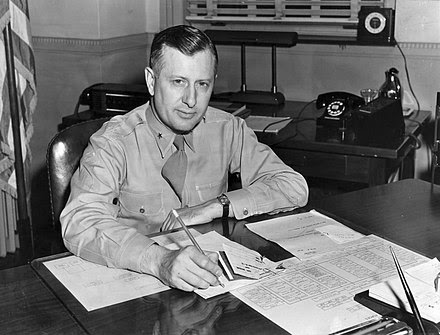
Historical Characters in "Cold War" - General William H. Tunner

 No novel about the Berlin Airlift could make any claim to accuracy and authenticity without including General William H. Tunner. Although his influence was felt only in stages, as he was granted increasing authority, he was the world's greatest expert in military air transport. As Commander of the Combined Airlift Taskforce, Tunner took charge of the Airlift and imprinted his own character upon it. His innovations and his forceful personality saved the Airlift from chaos and collapse at a critical juncture.

Tunner had been one of the first officers in the entire Air Force to specialise in air transport. He had helped establish the Ferrying Division and nurtured it from a handful of men to an organisation 50,000 strong and delivering 11,000 planes a month to domestic and overseas destinations. In fact, he can be largely credited with creating not only an organisation but an entire ethos and standard for air transport pilots. He passionately believed that transport pilots had a different mission and required different qualities than combat pilots. He was proud to claim that he had “proved that air transport was a science in itself; to be carried out at its maximum efficiency air transport must be run by men who … are dedicated to air transport – professionals.” [Tunner, Over the Hump, Office of Air Force History, 1964, p. 41] He had then, in August 1944, taken command the highly risky supply operation across the Himalayas – which had already defeated several previous commanders – and turned it into a spectacular success.

Tunner also had a reputation as a hard driver. His nickname was “Willy the Whip” and he claimed he didn’t lose any sleep over it. The official air force history of Air Transport Command described him as “arrogant, brilliant, competent. He was the kind of officer whom a junior officer is well advised to salute when approaching his desk.” In short, he was both the consummate professional air transport commander and the kind of commander who could be expected to get the job done – even if it was a job that the officers appointing him did not believe could be done. For more details on his impact on the Berlin Airlift see: Tunner Takes Command.

The below excerpt depicts a first meeting between General Tunner and the RAF Station Commander Gatow, my fictional character Robin Priestman. This scene is set on August 14, a time when the airlift operations of Britain and the United States were still independent, i.e. before the formation of the Combined Airlift Task Force and before Tunner became Priestman's indirect superior.

The USAF C-54 settled down at Gatow four minutes late and was led by the “Follow-Me” Land Rover to a hardstanding where Priestman awaited. The engines had not stopped spinning before the door opened and a US general in a khaki uniform and polished shoes jumped down onto the tarmac. He was trim, modestly good-looking with regular features, and a businesslike rather than a friendly demeanour. He returned Priestman’s salute, and he offered his hand with the words, “Thank you for seeing me at such short notice, Wing Commander.”

“Everything is short notice on this Airlift,” Priestman replied. “How can I help you?”

“Oh, I just thought I’d take a look at your operations and see how you were handling things. If you’ll wait one moment, my pilot and copilot are two of my staff officers. I want them to join us.” He looked toward the aircraft and on cue, two lieutenant colonels dropped out of it to be introduced as Bettinger and Foreman.

Priestman reciprocated by introducing, “Captain Bateman, RASC, responsible for our Forward Area Supply Organization or FASO. That is, everything to do with unloading the aircraft and moving the cargoes up to Berlin.” Priestman drew attention to the fact that Tunner’s aircraft was already being unloaded.

Tunner turned to watch as the trailer was backed up against the cargo door of his Skymaster. “I see you’re using German stevedores, just as we do. Any problems with them?” he asked.

Priestman nodded to Bateman to answer.

“None at this end. In the early days, German loaders were didn’t understand that the cargo capacity of aircraft varies. They knew even less about maintaining the aerodynamics of the aircraft by careful distribution of loads. Those teething problems have since been resolved.” …

Tunner snorted but nodded his understanding, then looked at Priestman. Taking this to mean Tunner was finished with the topic of unloading, Priestman invited the Americans into his car and drove them over to the maintenance hangar. Here Tunner and his staff officers met Gatow’s Chief Engineering Officer, Squadron Leader Holt. Tunner’s sharp eye rapidly noted, “You don’t have many aircraft in maintenance and almost no spare parts inventory. Why is that?”

“All Airlift aircraft are based in the West and that is where routine maintenance is carried out. We only maintain a limited supply of those essential components most likely to require immediate replacement such as tyres, brakes, etc.”

“What if an aircraft lands with a different problem?” Tunner asked, adding, “You seem to have ample hangar space to manage much more maintenance.”

“Our problem isn’t space but personnel. We only have enough ground crew here to handle an emergency. As for spare parts, the RAF doesn’t have infinite stockpiles and what we have is centralised at our main depot in the UK. If we lack something, it can be flown in within a couple of hours — a day at the most. As a rule, however, we prefer an aircraft’s regular crew to handle all repairs during routine maintenance.”

“You have crews assigned to individual aircraft?” Tunner sounded surprised.

“That’s right.”

“Isn’t that a waste of manpower?” Although his expression was impassive, his disapproval was evident.

“How so, sir?” Holt asked defensively.

“Well, 50-hour checks only come due every five or six days. What is the crew doing in the meantime?”

Priestman took over from the rattled Holt, “Squadron ground crews handle two aircraft each and the RAF requires daily inspections. In addition, squadron ground crews do the 150-hour inspections which come up roughly every fortnight. Our ground crews are working twelve-hour days. There’s no question of them lazing about.”

“You still do daily inspections? That seems over-cautious. We’ve found fifty-hour checks are adequate to correct minor issues and identify major ones,” Tunner countered.

Priestman was unimpressed. “Our philosophy is to carry out preventive not merely corrective maintenance. We prefer repairing an item in time rather than waiting for it to break down and need replacing.”

“That sounds like an admirable approach in peacetime, Wing Commander, but in war — or warlike conditions such as we have here — the primary concern must be maximum utilization of assets. That means aircraft should be flying, loading/unloading or undergoing maintenance. They shouldn’t be sitting around on the ground being inspected for problems they don’t yet have. My preference is to give them a thorough check at 200 hours. I’ve arranged for the C-47s to go down in Oberpfaffenhofen and the C-54s to fly to Burtonwood.”

That sounded as though it would take aircraft off the Airlift longer than the RAF’s daily inspections, but Priestman chose not to challenge the “expert.” Instead, he suggested they move on.

The tour continued to the Malcolm Club. Priestman explained that station personnel used the messes, while the Malcolm Club served the crews waiting for their aircraft to be unloaded. “The Salvation Army, NAAFI and YMCA also offer quick snacks from mobile canteens on the airfield or beside the maintenance hangars, but here men can sit down and get a bit of peace and quiet. They also have a barber shop if someone wants a haircut while waiting, and the lounge is well-stocked with newspapers and periodicals.” Priestman proudly pointed to a table where these were displayed. “If an aircraft is stranded here overnight, the club offers limited but comfortable accommodation.”

Tunner looked around the room critically. “The problem with nice places like this is that the crews get to chatting and smoking and reading when they ought to be flying. As of yesterday, my crews have orders not to move more than 10 feet away from their aircraft.”

“I’m sure that’s popular,” Priestman noted.

“I’m not here to win a popularity contest,” Tunner shot back. “As I said a moment ago, I want maximum utilization of assets, and that includes pilots.”

“And how do they get the weather report and file a return flight plan?”

“I send a jeep around with the operations officer, another with the weather report, and finally, a mobile snack bar manned by the prettiest girls the Red Cross could recruit in Berlin drives from plane to plane. The men don’t seem to be bitching too much.”

Priestman nodded acknowledgement rather than approval and asked if his guests wanted a tour of the full station including accommodations, messes, and recreational facilities, or if they preferred to go straight over to the meteorology section, operations room and the tower. Unsurprisingly, Tunner opted for the latter. 

As they mounted the steps of the main building, Tunner remarked, “I’ve asked my staff to work out new traffic patterns in the corridors, and I hope the RAF will cooperate… For a start, one-way traffic. Everything flies in via the northern and southern corridors and out via the central corridor.”

“That would be a great improvement and something I suggested long ago,” Priestman noted dryly. Tunner gave him a second look, but Priestman kept his eyes averted.

Tunner continued, “You’ve probably already heard that I’ve ordered all pilots who miss a landing to return fully loaded to avoid stacking up aircraft in the limited airspace over Berlin — and woe betide any pilot who misses his landing without good reason!”

Priestman nodded without commentary. He was not as averse to stacking aircraft as Tunner and felt sending loaded aircraft back was a waste of aviation fuel that also delayed the delivery of desperately needed supplies to Berlin. He conceded that in a situation such as had developed at Tempelhof yesterday, it was preferable to an accident, but he thought the decision should be made on a case-by-case basis.

Tunner next remarked, “I’ve asked the Pentagon to call up one hundred civilian air traffic controllers and send them over to improve the quality of the ATC. Some of our guys just aren’t experienced enough for this environment.”

Priestman nodded agreement wordlessly.

Tunner wasn’t finished, “I’ve also put in a formal request via General LeMay to Air Marshal Sanders to base a bunch of our aircraft in your Zone.”

That brought Priestman to a halt, and he looked over at the American surprised.

“Look, the distance to Berlin from either Wiesbaden or Rhein-Main is roughly 300 miles while it’s just over 120 miles from Celle or Fassberg and less than 100 from Hamburg. The same aircraft can make three trips to Berlin from Fassberg in the time it takes to make two sorties from Rhein-Main. That’s 50% more.”

Priestman nodded and conceded, “That makes sense.”

“What it means is that most of those planes will be funnelled down the northern corridor and directed into Gatow, starting one week from today.”

“Ah, I see. That’s why you were so keen to visit,” Priestman concluded with a faint smile.

“That was one reason. The other is that a C-74 is arriving today at Rhein-Main with vitally needed engines and other bulky replacement parts. Some genius in the Pentagon came up with the idea of stuffing it full of flour — after we’ve unloaded those special cargoes — and sending it on to Berlin. The problem with that is it’s far too heavy to land on the PSP runways at Tempelhof. If we’re going to make a show — and that’s all this is since the brass refuses to dedicate any C-74s to the Airlift — it is going to have to take place here at Gatow.”

“I see,” Priestman commented dryly. He didn’t like having something like this sprung on him at such short notice.

Tunner could read his mood and tried to make the event more palatable. “It wasn’t my idea, but to be fair, something like this will highlight that this is a joint effort — even if it is still, irrationally, two separate operations.”

Intentionally or not, Tunner had just shown his hand. The American general wanted a combined operation. More specifically, he wanted to control not just the U.S. aircraft and airfields but the British ones as well. That way they would all have to dance to his tune.

Priestman had mixed feelings about that. He could see the sense in many of Tunner’s suggestions and disliked Bagshot’s small-minded approach to problems. Yet the American general also struck him as rigid and adverse to alternative approaches. Tunner appeared to believe he had all the answers already. Most damning, his obsession with “maximum utilization of assets” struck Priestman as almost inhuman.

[i] Tunner, P. 41.

[ii] Tunner, p. 110.

[iii] Oliver LaFarge, The Eagle in the Egg, p.26.

Tunner is a character in the Second two volumes of the Bridge to Tomorrow Trilogy

Berlin is under siege. More than two million civilians must be supplied by air -- or surrender to Stalin's oppression.

USAF Captain J.B. Baronowsky and RAF Flight Lieutenant Kit Moran once risked their lives to drop high explosives on Berlin. They are about to deliver milk, flour and children’s shoes instead. Meanwhile, two women pilots are flying an air ambulance that carries malnourished and abandoned children to freedom in the West. Until General Winter deploys on the side of Russia. Buy now!

 Based on historical events, award-winning and best-selling novelist Helena P. Schrader delivers an insightful, exciting and moving tale about how former enemies became friends in the face of Russian aggression — and how close the Berlin Airlift came to failing. 

 Watch a Video Teaser Here!

 Winning a war with milk, coal and candy!