Helena Schrader's Historical Fiction

For a complete list of my books and awards see: http://helenapschrader.com

For readers tired of clichés and cartoons, award-winning novelist Helena P. Schrader offers nuanced insight into historical events and figures based on sound research and an understanding of human nature. Her complex and engaging characters bring history back to life as a means to better understand ourselves.

Showing posts with label crusader states. Show all posts

Sunday, December 20, 2015

The Urban Difference: The Rising Middle Class in the Crusader Kingdoms

As I mentioned a couple of weeks ago, Balian was a "poulain" -- a native of the crusader kingdoms, born and raised in "Outremer." Although his personal wealth was rural (as for feudal lords in the West), he lived in a society that was exceptionally urban for its time.

In fact, it has been estimated that roughly 50% of the Frankish population in the crusader kingdoms was urban. That represents a much higher proportion than in Western Europe at this time, and by the post-Hattin era, even the majority of noblemen were dependent on non-agricultural income for their wealth. In short, the degree of urbanization in the Kingdom of Jerusalem, particularly the 13th century Kingdom, resembled the Italian city states more than the large western kingdoms such as England and France. To understand the crusader kingdoms, therefore, it is important to understand the urban economy.

The Medieval cities of the Holy Land had many covered markets similiar to these in 
Acre (left) and Jerusalem (right).

The most obvious source of wealth was the control of the key ports along the coast of the Levant which meant the points at which the “riches of the Orient” were transshipped for export to the increasingly prosperous population of the West. It was in Beirut and Tyre, Acre and Caesarea, Jaffa and Ascalon that Damascus steel and Indian spices, Ethiopian incense and Nubian gold, Persian carpets and Chinese silk, African ivory and Egyptian papyrus were exported to the hungry markets of Italy, and from there onward to the Holy Roman Empire, France, Iberia and far off England and Scandinavia.


The port of Acre was the most important in the crusader states.

In addition to these transshipped items, the crusader kingdoms themselves had a number of export goods that were highly lucrative. While sugar was probably the most important bulk commodity, the export of Holy Relics and souvenirs should not be under-estimated. By some estimates, the population of Jerusalem doubled during the summer pilgrimage (tourist) season, and all of those pilgrims wanted to take some mementos home with them as well as gifts for family and friends, just like modern tourists today.

All those pilgrims also needed a place to stay and food to eat — and not just in Jerusalem. The pilgrimage sites included not just obvious sites such as Bethlehem and Nazareth, but also the site of every moment in Christ’s life as recorded in the Gospels, and places associated with the Virgin Mary, Mary Magdalene, and other saints. There was hardly a place in the entire Kingdom of Jerusalem that could not lay claim to some biblical event of importance, and devout pilgrims, who ventured so far at such cost and risk, generally stayed until the fall sailing season, which meant spending roughly six months in the Holy Land. In short, the pilgrimage “service industry” was, in proportion to the population of the time, at least as important as tourism is to Israel today.

The Knights Hospitaller provided hostles, hospices and hospitals for the pilgrims. Above the Hospitaller compound in Acre.

Last but not least, a large proportion of the Latin settlers were skilled craftsmen. Serfs could not legally leave their villages and lands (and most probably didn’t want to), so the pilgrims, whether armed and unarmed, were predominantly men of higher status: craftsmen, guildsmen, or merchants. They brought their skills with them, and established themselves in the cities and towns of the crusader kingdoms, where they worked side-by-side with native craftsmen. Here some of the most productive if most prosaic of inter-cultural exchanges took place in the development of dying and cloth-making, leather-working, gold and silver smithing, pottery, carpentry, masonry, glass-working, and all the countless other skills essential to survival and a high contemporary standard of living.

An example of crusader pottery.
Based on the names of the streets alone, it is clear, for example, that Jerusalem had a high concentration of furriers and tanners, but also gold and silver smiths. Pottery from the region, glazed on the inside, is known to have been a particularly popular practical ware, (an early version of Teflon), and that glass-makers and glass-blowers were renowned. The massive construction projects undertaken primarily in the mid-12th century, ensured work for carpenters, masons and sculptors, and the remaining fragments of their work are testimony to the high quality of their workmanship.

At the high-end, Jerusalem also exported illustrated manuscripts from a scriptorium established by the Canons of the Holy Sepulcher. Books produced in such a sacred place had an added value beyond the high quality of the work, and undoubtedly represented one of the luxury goods with the highest margins exported from the crusader kingdoms — albeit, as with all truly valuable, custom made objects, only in very small quantities. 

The crusader kingdom of Jerusalem, far from being a wasteland inhabited by barbarians, was a highly cultured, economically dynamic powerhouse.

Learn more about crusader society at: Balian d'Ibelin and the Kingdom of Jerusalem.

The first two books in the Balian d'Ibelin series, Knight of Jerusalem and Defender of Jerusalem are available for purchase.


A landless knight, 
a leper king,
and the struggle for Jerusalem.


 A divided kingdom,
a united enemy,
and the struggle for Jerusalem


Buy now in Paperback or Kindle format!                                                 Buy now!


Sunday, December 13, 2015

The Source of Baronial Wealth in the Crusader Kingdoms

Balian d'Ibelin, the hero of my novels Knight of Jerusalem and Defender of Jerusalem was a baron in the crusader Kingdom of Jerusalem. As such his source of wealth was land, and understanding the rural economy from which he drew his wealth and strength is important to understanding Balian himself. 

Whether in films like “Kingdom of Heaven” or in novels like “Jerusalem” by Cecilia Holland, the crusader Kingdom of Jerusalem is most frequently depicted as a desert wasteland dotted with massive castles on barren hills. This image traces its roots at least in part to accounts by crusaders and pilgrims from Northern Europe, who found the Holy Land oppressively hot and comparatively dry. But those images are deceptive.

The View to the East from Jerusalem today.

First, modern students of the crusader states should keep in mind that most pilgrims arrived in the spring, at the start of the warm, dry season, and departed in the fall before the rains.  Crusaders who remained longer in the Holy Land, like Richard the Lionheart, encountered drenching rain and even sleet and hail along with far less than tropical temperatures. More important, despite some climate change over the last 800 years, it is reasonable to assume that the climate of the “Land of Milk and Honey” is not so very different today from what it was during the period of the crusades.


The coast near Ascalon today; crusader agriculture was concentrated on the fertile plane.

In short, far from being a crucible of heat and sand, the Holy Land under crusader rule was highly fertile and agriculturally productive. That was what made it so valuable to invaders from all corners of the earth over the millennia!

But the new rulers from the West did not simply take over the existing territory, they increased its productivity substantially. Of the estimated 650,000 inhabitants of the Kingdom of Jerusalem in the second half of the 12th century, roughly 140,000 were “Franks” — Frank being the collective term for the Western Europeans that came to the Holy Land in the 12th and 13th centuries. Of these, roughly half lived in rural villages. These seventy thousand rural “Frankish” settlers lived predominantly, archaeologists believe, in new settlements and so represented a significant influx of new agricultural labor and — even more important — brought more land under cultivation.    

One important innovation from the West was the use of horses as opposed to oxen for plowing.
Equally important and far too often under-estimated, the Western settlers that came to the Holy Land during the first century of Latin rule, adapted their agricultural techniques to the new environment so effectively that their presence led to what historian Malcolm Barber calls a “agricultural revival” of the region. Thus, in addition to traditional Mediterranean products such as wheat, barley, olives and grapes, with which the natives of the region were already familiar, the Western settlers in the crusader states developed commercial production of dates, sugar cane, figs, bananas and citrus fruits. The cities of Outremer — including Jerusalem itself — were not surrounded by barren desert but rather by a blooming agricultural landscape of orchards and plantations catering to the urban population.

The ancient olive orchard outside Jerusalem - The Mount of Olives - as probably been here since crusader times.

The archaeological evidence further suggests that the typical settler village was not walled, did not have a citadel or tall keep or even a defensible church tower as in other “frontier” areas as, for example, Prussia. This discovery strongly undermines the notion that the Franks lived in constant fear of the more populous native population. Rather the pattern of settlement reproduced typical settlement patterns of Southern France adapted architecturally to the climate, and so reinforces the thesis that the Franks in Outremer lived in harmony with their neighbors.  The great castles and walled cities were built to protect the entire population from foreign (Saracen) invasions, not to protect the local lords from their subjects.

A Frankish Sugar Mill -- a Familiar Sight in the Rural Landscape of the Crusader States
It should also be remembered that even the non-Frank workers on the farms and in the factories were not slaves. They were for the most part natives of the region, which meant they were predominantly Christian and their status was similar to that of serfs in Western Europe. They had clearly defined rights and privileges as well as obligations, and they were ruled by local administrators of their same faith, who administered traditional law rather than imposing foreign customs on the population. Even Muslims and Jews retained a strong degree of judicial autonomy in settling civil cases.

Far from being the desert battleground of popular literature and film, the Kingdom of Jerusalem — like the Kingdom of Cyprus — were agriculturally fertile, rich kingdoms in a mild, Mediterranean climate. This was the land of “milk and honey” that had seduced — and continues to seduce — conquerors since the start of recorded time.

Learn more about crusader society at: Balian d'Ibelin and the Kingdom of Jerusalem.

The first two books in my Balian d'Ibelin series, Knight of Jerusalem and Defender of Jerusalem are available for purchase.


A landless knight, 
a leper king,
and the struggle for Jerusalem.


 A divided kingdom,
a united enemy,
and the struggle for Jerusalem


Buy now in Paperback or Kindle format!                                                 Buy now!

Sunday, December 6, 2015

The Crusader States: The Setting of the Balian d'Ibelin Trilogy

My current project, a three-part biographical novel of Balian d'Ibelin, is set in the crusader states established by the First Crusade. Over the next four entries, I want to "set the scene" for the novels by telling you more about the crusader states and so the world in which Balian lived. 


City of Jerusalem from the Mount of Olives today.
While most people have heard of "the crusades," not everyone realizes that the first crusade re-established Christian rule over some parts of the Holy Land, notably Antioch and Jerusalem, that lasted between 40 and 200 years.  Because the Western knights and noblemen who finally made it to Jerusalem felt they had been betrayed by the Byzantine Emperor, they did not turn the territory which they had conquered over to Byzantine control, instead they established a series of independent states with Christian rulers: the Principality of Antioch, the County of Edessa, the County of Tripoli, and – most important – the Kingdom of Jerusalem.

The Arms of the Kingdom of Jerusalem
 
Initially, these "kingdoms" were little more than Christian-controlled islands in an Islamic sea, separated from one another by large swaths of territory. Between 1099 and 1144, however, the Christians steadily increased their area of control -- in most cases giving the defeated Muslim defenders of cities and castles a safe-conduct after surrender. By 1144, the crusaders controlled the entire coastline of the Levant from south of Gaza to roughly Antalya. In short, the crusader kingdoms covered all of what is now Israel, most of modern Jordan, Lebanon, and parts of Syria and Anatolia as well.

Copyright Helena P. Schrader
The crusaders who founded and ruled these states were a tiny elite of Latin Christians from Western Europe, dependent economically on the local population – composed predominantly of Byzantine, Syrian, and Maronite Christians, with smaller populations of Jews, Muslims, and new settlers from the West – all speaking a variety of languages. Although Latin churches were built and the various Latin religious orders soon established a presence, neither the Orthodox Churches, nor the synagogues and mosques were destroyed or closed; the inhabitants of the crusader kingdoms were free to follow their religious conscience. 

Acre, scene here, was always one of the most cosmopolitan of the Crusader cities.
Furthermore, the states were at the crossroads of trade between East and West, and the ports of Christian Palestine were the key points for trans-shipping the riches brought by caravan from China, Persia, Egypt, and Arabia to the entire Western world. This made these states both prosperous and cosmopolitan. The crusader states, known collectively in the West as “Outremer” (beyond the sea), rapidly became a melting pot for culture and a breeding ground for art and science.
The natives of these states, including the settlers who came from the West, soon identified with their new homeland. Fulcher of Chartes, writing in 1125, could already report of the crusader states that:
Westerners, we have become Orientals. The Italian and Frenchman of yesterday have been transplanted and become men of Galilee or Palestine...We have already forgotten the land of our birth; who now remembers it? Men no longer speak of it.

These settlers also adapted to their environment. They learned to speak some Arabic just to be able to communicate with their neighbors, their tenants, and with tradesmen and merchants. They adapted their clothes to the hotter temperatures, wearing more silk and less wool and fur, although they never adopted Arab or Turkish fashions. They naturally learned to cook foods from what was grown locally, and they could afford to eat "exotic" foods like lemons, oranges, figs and pomegranates, simply because such foods were not exotic in the crusader states. They could also afford other "luxuries" like sugar, glass and frequent baths for the same reason: such luxuries weren't costly in their new environment. 

Ivory was another luxury more common in the East; here the cover of a book from the Kingdom of Jerusalem
This adaptation to their new habitat, however, made the Latin settlers in the crusader states and their descendants suspect in the eyes of later waves of crusaders. The latter gave the former the derogatory appellation "poulains." At least from the Second Crusade onward, Western leaders and armed pilgrims viewed the poulains as "decadent" and "treacherous." Balian d'Ibelin was a poulain, a native of the crusader states, not a crusader.

The first two books in the series, Knight of Jerusalem and Defender of Jerusalem are available for purchase.


A landless knight, 
a leper king,
and the struggle for Jerusalem.


 A divided kingdom,
a united enemy,
and the struggle for Jerusalem


Buy now in Paperback or Kindle format!                                                 Buy now!


Friday, June 26, 2015

A Destrier's Tale Part IX: The Arab Mare

A Destrier’s Tale
Balian d’Ibelin’s Destrier “Centurion” Tells his Story
Part IX: The Arab Mare


Christians are very respectful and protective of mares. Even the Black Knight never took one of his mares anywhere near the Horse-Haters. The Christians keep mares where they can raise their foals in peace, and they are only ridden by their own human mares and sometimes human foals. The Saracens, on the other hand, use slave mares in battle. I suppose they might be afraid stallions will rebel and run away. Or maybe they don’t have enough stallions. Whatever the reason, many of them ride mares even when they invade to attack us.

After the other knights had chased the Horse-Haters back where they’d come from, Lord Balian and the other knights, squires and horses from Ibelin who were still alive started for home. We hadn’t gone far before we came upon one of the Saracen slave-horses. Lord Balian said she was an Arab mare.

Like me after my first battle, she was standing forlornly by the spring, evidently abandoned. She was pretty — even caked with dried sweat, covered with dust, and with burs in her mane and tail. She was a rich chestnut color, with a cheeky blaze that curled a little over her left eye. She was dainty, with neat little feet and a rounded rump that was wonderfully inviting.

Somehow she’d managed to get rid of both her bridle and saddle, but her knees were torn open and caked with dried blood still oozing fresh blood here and there. The knees were in such terrible shape, it hurt her to bend them so she couldn’t move without pain. Some of the humans wanted to put her down at once. Dawit wouldn’t hear of it. He protested vehemently to Lord Balian, and although I couldn’t understand his flood of words, his meaning was clear: she was bruised and scraped but she would heal if given care and time. Lord Balian nodded and gave him permission to bring her along with us.

She didn’t want to come at first. She was clearly terrified of the Christians. The Saracens had obviously told her lies about them, saying they would hurt her. But she couldn’t run away from us on account of her stiff, scabbed knees. She tried, of course, tearing all the scabs off and starting a new rush of blood, but when she gave up in despair, Dawit took her in hand. He didn’t just calm her, he had some ointment he rubbed on her knees that made them feel better almost at once. When the men mounted up to continue, Dawit had both her and me on the lead behind him.

I was happy about that because I could tell she was a nice filly and I could sense how frightened she was. I tried to ease her fear and distract her from the pain in her knees by telling her how nice it was in Ibelin. I told her my first owner (I didn’t mention how terrible he was) had been killed in a battle just like hers, but that I’d then been taken in by Lord Balian, nodding to him as he rode ahead of us on Rufus.

“Usman wasn’t killed,” she nickered to me in a soft, sad voice, “he abandoned me!” You should have heard the pain in her voice! She hung her head in shame too.

“Surely he just couldn’t find you,” I comforted her, thinking she might not know how easily humans were killed if unhorsed.

“No,” she sighed, dropping her head even lower with her ears hanging down in misery. “He came and took his precious saddle, but he left me to starve.”

“But why would he do that?” I protested.

She sighed and her nose was all but dragging on the ground. “He blamed me for stumbling. He said I nearly broke his neck. He said I was lucky he didn’t kill me.”

“Well!” I assured her indignantly. “He was right about that because now you’re with us, and we’ll take good care of you. Lord Balian has miles of orchards and he gives us apples and pears and even pomegranates!”

She looked at me sidelong from under her beautiful lashes as if she didn’t believe me, but I could see a flicker of hope in her eyes too. “Really?”

“Really!” Then I asked her to tell me more about herself.

She had lived a very sheltered life it seemed, and was still a virgin. I was glad to learn that because it would have been embarrassing if she’d had more experience than me. In fact, she said she’d hardly been around stallions at all, but she’d had several riders and Usman was only the last in the series. She said she’d fallen a little in love with him because he was so masterful and other men seemed to look up to him, although he was an archer not a lancer.

That evening when we camped and we were all turned out to graze, some of the other stallions came sniffing around. A couple of young studs (you know the kind, brutes that think mares are only good for one thing) tried to harass her. I chased them away in no uncertain terms, biting one so badly that he bled, and Rufus gave me a warning nicker because he belonged to a strange knight who was riding with us for some reason. I didn’t care if I left scars! Amira – that was what Lord Balian later called her — wasn’t in season and she was wounded and frightened and shy. They had no business coming anywhere near her. She stayed near me after that, grazing so close we could swat away each other’s flies and sometimes brushing against one another. I loved that.

The next day already, she was must happier. She held her head higher, lifted her ears and she even started to pick up her feet, not shuffle along as she had the day before. Dawit was pleased with her progress too, pointing it out to Lord Balian. He smiled at us and nodded. When we paused for water later, he came back and inspected her with interest for the first time, checking over her knees and noting her other cuts and scrapes. Then he turned to me and put his palm on my forehead under my forelock. It had been nearly a year before I had overcome the memory of the Black Knight’s beatings enough to let him do that. “Found a lady, have you?” he asked me. I leaned against him and rubbed my head on his shoulder to tell him she certainly was a lady and he had to treat her right.

When we got back to Ibelin, everyone who had been left behind was aflutter at our return. They made a huge feast, you could smell it everywhere, and Mathewos ordered the grooms to give us all proper baths and we had molasses pellets in our feed that night and the deepest, softest bedding ever. Still, I was a little sad because Amira and I were separated for the first time since we’d met; she was given a stall with the other mares at the other end of the stables.

After that we rarely had a chance to exchange more than a nicker or two. I always greeted her when I was led in or out and she invariably stood with her head over her stall door when I came or went. I saw that her knees healed perfectly except for some scars. Once, when we went out to the tiltyard, she was in the paddock, and she lifted her tail and galloped along beside the fence to show me how beautifully she moved and how fast she was. I could have watched her all day! Lord Balian laughed at me and patted my neck, admitting she was a “fine filly.”

Then one evening not long afterwards, when Dawit was bringing me in from the paddock at dusk, Amira was waiting for me in her stall and as I passed her she muttered in a very soft nicker: “I’m in season.”

I stopped dead in my tracks and I looked at her. Our eyes met. She wanted me!

Dawit was clicking and tugging at the lead, but I couldn’t move. I was paralyzed by desire. Dawit laughed and yanked down firmly on the lead. “Get it out of your head!” He told me firmly ‘though kindly. “She’s not for the likes of you!”

Not for me? The shock broke my resistance for the moment, and he led me to my stall and turned me loose inside. But I wasn’t interested in my feed or even water any more. Amira wasn’t for me? Why not? And if not for me, then for who? Surely they weren’t going to let one of the household stallions have her? How could they? I was Lord Balian’s destrier! Rufus? No, he was as much a virgin as I was. Gladiator? For the first time I looked at my predecessor with anger and jealousy. He got all the mares, just because he wasn’t good for anything else! To make matters worse he started called down to Amira, “hey little Arab? Ready for a real stallion at last?”

Amira didn’t dignify him with an answer, and I screamed at her, “Don’t believe him! He’s a broken down nag! He can’t walk on four legs and he’s got rotten teeth!” (Which wasn’t true, but I hated him in that moment.)

“Centurion!” She cried in a high-pitched terrified whinny: “Don’t let him rape me! I don’t want anyone but you! Please, Centurion.”

I screamed back to her that I would rather die than let any other stallion near her.

All our whinnying, of course, upset the humans. Matthewos came out and admonished me to “behave” — as if I was the one causing trouble! Then he ordered one of the junior grooms to take Amira and a couple of the other mares outside to the paddock.  A half hour later they came to get Gladiator too. He pranced out with his crooked, lame-assed gait, flicking his tail at me and all but crowing in triumph.

I started making runs at the stall door to break it down. When that didn’t’ work, I turned around and kicked at it with the full force of my hind legs, twice, three, four times. The door held. I started pacing around my stall again, I was sweating and I swung my head back and forth at knee level as I tried to think how to escape and rescue Amira.

Someone must have told Lord Balian what a state I was in because suddenly he was at the stall door. It was completely dark by now and the stable was lit only by some oil lamps. Lord Balian never came to the stables after dark, but he was here and Mathewos with him.

“He won’t drink or eat,” Mathewos reported accurately.

I flattened my ears on my head and snapped furiously at Mathewos. He knew perfectly well what the problem was!

Lord Balian did too. He glanced over his shoulder at Amira’s empty stall. “There’s nothing wrong with him that Amira can’t cure.”

Mathewos shook his head firmly. “They are a bad match, my lord. Too similar in temperament. Any foal they produce will be more nervous than nine cats, and, as for looks, greys and chestnuts don’t mix. You’re likely to get either ugly markings or a roan.”

Lord Balian nodded, and said, “I’m sure you’re right, Mathewos. Let me walk him a bit.”

Obviously that was an order not a request, and Mathewos had no choice but to hand him my halter but his whole expression and demeanor expressed his disapproval. Lord Balian stepped into the stall and looked me in the eye. I was so agitated I glowered back at him, but I also figured if he took me out of the stall, I had a better chance to break free so I let him slip the halter over my head. Then I followed him out of the stables, across the ward, and out the postern that led to the paddocks.

As soon as we were beyond the walls I froze and lifted my head to find out where Amira was. There were several different paddocks, you see. I lifted my head and sniffed the air. She had already seen me. She lifted her voice and squealed in a frenzy of passion. “Centurion!”

That was all I needed. I bolted. If Lord Balian had tried to stop me, I would have dragged him with me. But he didn’t. He just let me go. I galloped straight past a dismayed Gladiator, who was in one of the small paddocks by himself, and I screeched to a halt opposite Amira. Now there was only the fence between us but there wasn’t space to make a running start at that fence. I started running back and forth in the lane between the paddocks, while Amira kept pace with me, calling my name. I was on the brink of trying to take that fence from a standstill, when Lord Balian appeared again. He unlatched and opened the gate to let me in. I put my head down and my tail up and galloped right past him to Amira.

When our passion had been sated, we grazed together side-by-side just as we had the first days we met. Later, we lay down to sleep a bit and she stayed so close I could feel her warmth against me. It was the most beautiful night of my whole life.

Mathewos was wrong about our foal to. Well, half wrong. I have to admit that she wasn’t pretty by most standards. Her coat was a very light chestnut, a bit of a roan to be honest, and she had a white face and four white socks, but she was the sweetest little filly you’ve ever seen. Born in love, she came into the world full of it, and when Lord Balian’s timid daughter Helvis needed a horse that she could trust absolutely and always, Lord Balian’s choice fell on our Ginger. But that is getting ahead of my story.

Life in the Kingdom of Jerusalem in the last decade before the fall of Jerusalem to Saladin is described (from human perspective) in:


Book II of  the Balian d'Ibelin TrilogyBuy Now in Paperback!  


Centurion is also a character in Book I of this Biographical Novel:


A landless knight,
                       a leper king,                                                                                          and the struggle for Jerusalem!

Knight of Jerusalem: A Biographical Novel of Balian d'Ibelin, Book I, is a B.R.A.G. Medallion Honoree and finalist for the 2014 Chaucer Awards for Historical Fiction.

Buy now!


Friday, December 5, 2014

Balian's Wife: The Controversial (and much maligned) Maria Comnena

Historically, Balian d'Ibelin married the Dowager Queen of Jerusalem, Maria Comnena, who English chroniclers called "scheming" and modern historians and novelists alike have vilified. I think unjustly. 

In Bernard Hamilton’s essay “Women in the Crusader States: Queens of Jerusalem 1000 - 1190” published in Medieval Women (ed. Derek Baker, Basel Blackwell, Oxford, 1978), Hamilton argues that it was Agnes de Courtney’s “misfortune” to have “bad relations to the press.”  He notes that “all contemporary sources are hostile to her”, but argues that that “her influence was not as baneful as the Ibelins and the Archbishop of Tyre would like posterity to presume.” He then goes on to describe Agnes’ rival, Maria Comnena, as “a ruthless and scheming woman.” Now Bernard Hamilton is a noted historian, but my father taught me to judge a person by his/her deeds — not by what others said about them.

So let us look at the record, not the reputation, of the wives of Amalric I of Jerusalem: Agnes de Courtney and Maria Comnena.


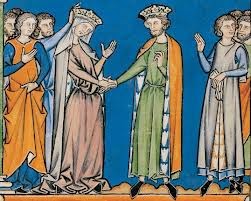
Medieval King and Queen

Agnes de Courtney was, according to Malcolm Barber, betrothed to Hugh d’Ibelin, but instead married Prince (later King) Amalric of Jerusalem. Whether she did this voluntarily is not recorded. She might have been seduced or abducted, but she might also have been very happy to give up the comparatively obscure and unimportant Hugh in favor of the heir apparent to the throne.  Whatever her motives at the time of her marriage, when Baldwin III died childless, the High Court of Jerusalem had such strong objections to Agnes that they refused to acknowledge Amalric as King of Jerusalem unless he set Agnes aside. Why, we do not know. There was the issue of being married within the prohibited degrees on consanguinity, and the issue of the pre-contract with Hugh d’Ibelin, both of which were canonical grounds for divorce.  However, the objections of the High Court are not likely to have been legalistic in view of the fact that the High Court explicitly recognized Amalric’s children by Agnes as legitimate.  This strongly suggests that the High Court was not uneasy about the legality of Amalric’s marriage but about the character of his wife. Perhaps it was simply the fact that she was a powerful woman, or a notoriously grasping one, or perhaps, as the Chronicle of Ernoul suggests, she was seen as insufficiently virtuous for such an elevated position as queen in the Holy City. Such speculation is beside the point; the naked fact is that Agnes was found unsuitable for a crown by the majority of the High Court. That’s a pretty damning sentence even without knowing the reason, and that’s not just a matter of “bad press.”


A King receiving the advice of his Vassals

Agnes then married (or returned to) her betrothed, Hugh d’Ibelin, and, when he died, married yet a third time. Until the death of King Amalric, she had no contact with her children by him, and even after Amalric’s death, during her son Baldwin’s minority, she appears to have been excluded from the court. Then in 1176, Baldwin IV took the reins of government for himself and invited his mother to his court. Within a few short years, Agnes de Courtney had succeeded in foisting her candidates for Seneschal, Patriarch and Constable upon her young and dying son. These were respectively: 1) her utterly underwhelming brother, Joceyln of Edessa, 2) the controversial figure Heraclius, who may not have been as bad as his rival William of Tyre claims and may not have been Agnes lover as the Chronicle of Ernoul claim, but hardly distinguished himself either, and finally an obscure Frenchmen, also alleged to have been Agnes’ lover, Aimery de Lusignan. Not a terribly impressive record for “wise” appointments – even if Aimery de Lusignan eventually proved to be an able man.

Hamilton next applauds Agnes “cleverness” in marrying both heirs to the throne, her daughter Sibylla and her step-daughter Isabella (Maria Comnena’s daughter), to “men of her choosing.” We are talking here about Guy de Lusignan and Humphrey de Toron respectively. The latter was a man of “learning,” who distinguished himself by cravenly vowing allegiance to the former after Guy seized power in a coup d’etat that completely ignored the constitutional right of the High Court of Jerusalem to select the monarch, and then promptly got himself captured at Hattin. Although he lived a comparatively long life and held an important barony, he apparently never played a positive role in the history of the kingdom. Not exactly a brilliant match or a wise choice for the future Queen of Jerusalem.

Agnes’ other choice, the man she chose for her own daughter according to Hamilton, was even more disastrous. At best, Guy de Lusignan was freshly come from France, young, inexperienced and utterly ignorant about the situation in the crusader kingdoms.  At worst he was not only ignorant but arrogant and a murderer as well: he allegedly stabbed the unarmed and unarmoured Earl of Salisbury in the back, while the latter was escorting Queen Eleanor of England across her French territories. He certainly alienated his brother-in-law King Baldwin IV within a short space of time, and he never enjoyed the confidence of the barons of Jerusalem. This is not a matter of “hostile sources” just the historical record that tells us the dying king preferred to drag his decaying body around in a litter -- and his barons preferred to follow a leper – than trust Guy de Lusignan with command of the army.

Nor was this mistrust of the baronage in Lusignan misplaced. When Sibylla crowned her husband king and all the barons but Tripoli grudgingly accepted him, he led them to the avoidable disaster at Hattin. In short, Agnes de Courtney’s interference in the affairs of the Kingdom of Jerusalem, led directly to the loss of the entire Kingdom.


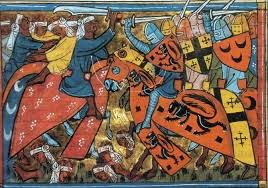
A medieval depiction of the disastrous Battle of Hattin

In contrast, there is only one known instance of Maria Comnena actively intervening in the affairs of the Kingdom. This was when she pressured (or “browbeat” according to Hamilton) her daughter Isabella into assenting to the annulment of her marriage with Humphrey de Toron and accepting Conrad de Montferrat as her husband. Hamilton portrays this as an act of unbridled, sinister power-seeking on the part of Maria.  Why Agnes’ five appointments should be “clever” (despite the disastrous consequences) but Maria’s effort to rescue the kingdom from the appalling and patently destructive leadership of King Guy should be seen as “power-hunger” on the part of Maria is baffling. It is certainly not an objective assessment of the behavior of the two women.

True, Isabella appears to have become fond of Humphrey de Toron, but she was the heir to the throne and princesses do not marry for the sake of their own pleasure but rather for the sake of the kingdom. To an objective observer, forcing an eight year old girl to marry a total stranger is considerably more manipulative and inhumane then for the a mother of a 17 year old princess to put pressure on her daughter to put the interests of the kingdom ahead of her personal preferences. 

To make matters worse, Hamilton reports – with apparent approval! – that Agnes prevented the child Isabella from visiting her mother, effectively imprisoning her in her castle at Kerak from the age of 8 to the age of 11, a period in which, incidentally, Kerak was twice besieged by Saladin. In short, Agnes was hardly keeping Isabella “safe” – she may even have been courting her capture and death to ensure there was no rival to her own daughter for the throne.  But as that is speculation, I will leave motives aside and focus on the fact that she keep a little girl imprisoned in an exposed castle, denying her the right to even visit her mother.


Medieval Mothers were not less fond of their children than mothers today!

In short, Hamilton suggests it is legitimate – indeed clever -- to separate an eight year old from her mother and step-father and expose her to danger, but it is devious and self-serving when the mother of a seventeen year old persuades her to set aside the husband forced on her as a child. That’s a warped view of affairs in my opinion.

The English chroniclers and Hamilton attribute to Maria evil motives and accuse her of “scheming” and deviousness without bringing forth a single example to support these allegations – aside from the above instance of pressuring her daughter into an unwanted divorce. In her one recorded act of “interference” she induced her daughter to marry not some adventurer, who would lose the kingdom, but the only man the barons of Jerusalem were willing to rally around after the disaster of Hattin. Her choice for her daughter was a proven military commander, who had just rescued Tyre from falling to Saladin. So even if her “interference” was as selfish and self-seeking as Hamilton implies, it was considerably wiser than Agnes’ choice of Guy de Lusignan.


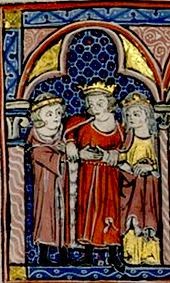
Medieval Depiction of Isabella's Marriage to Humphrey de Toron -- but as she was only 11 at the time, it's more likely a picture of her marriage to Henry of Champagne, sponsored as the depicted, by King Richard I

After this one act, although her daughter was queen of Jerusalem from 1192 to 1205 and Maria herself did not die until 1217, there is not a single instance of her “interfering” in the affairs of the Kingdom again – very odd behavior for Hamilton’s unscrupulous, devious and power-hungry woman.  In short, not a single fact supports his allegations against her.

Even taking into account how historians love revisionism, an objective observer ought to recognize that the contemporary sources favorable to Maria may indeed have had justification and just as much reason to condemn Agnes de Courtney. It’s time modern historians stopped slandering Maria Comnena just for the sake of re-writing history.